Scroll to top

Vodniy Jurnal

kolyajivoy

Water magazine No. 7 Helicoprion

Water magazine No. 7 Helicoprion

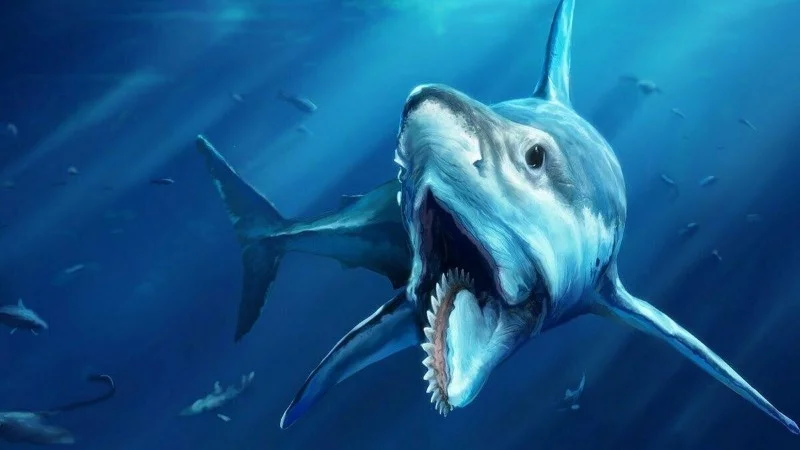
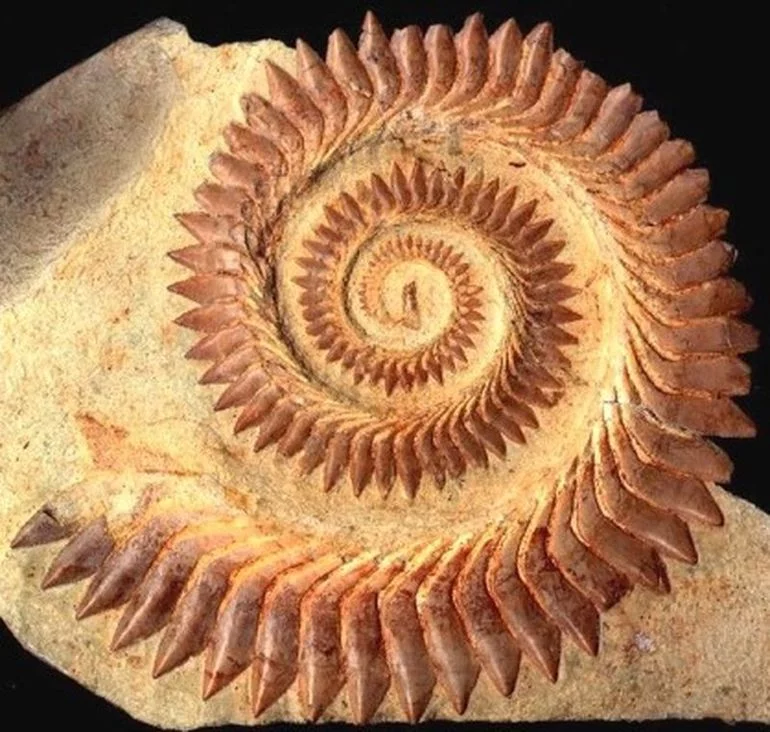
Helicoprion is an extinct genus of cartilaginous fish from the Carboniferous and Permian periods. The complete remains of the helicoprion have not yet been found. It is not entirely clear exactly how the spiral grew. Initially, it was believed that the largest teeth were the newest and, accordingly, were located closer to the place of attachment of the "spiral" on the jaw (the lower jaw could be bent down). Academician L. P. Tatarinov considered this unlikely — most likely, the teeth grew from the center of the spiral, and the smallest teeth are the youngest. This is confirmed by the direction of the "spurs" on the teeth — in all related species they are directed backwards. As they grew, the larger old teeth were pushed forward and shed. The spiral was "packed" into the symphysis cavity and only large "old" teeth were visible from the outside. The dental spiral of helicoprion is one of the most mysterious fossils of the Permian period. It consists of a series of sharp teeth-blades having a common spiral-rolled root with 80-190 teeth. The diameter of the spiral of the typical type of helicoprion reached 25 cm. This assumes the length of the entire fish is about 2-3 meters. Spirals up to 90 cm in diameter are described in the literature. The length of their owner could reach up to 9-12 meters. These fish are not sharks in the modern sense of the word, but representatives of primitive cartilaginous, close to the ancestors of chimeras and sharks.
Helicoprion Dental Spiral 
Helicoprion Dental Spiral 

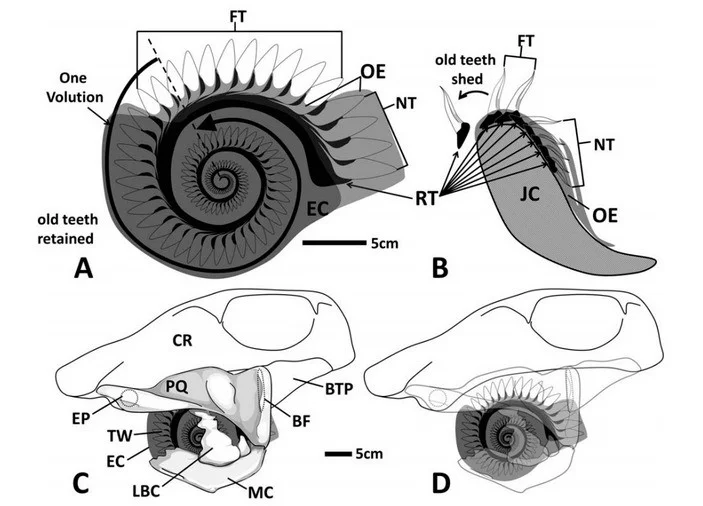
Comparison of the growth of the dental spiral of a helicoprion with the jaw of a shark: in helicoprions, old teeth were preserved in a spiral, in sharks they fall out (FT — functioning teeth, NT — new, not yet functioning teeth). A is the dental spiral of the helicoprion, B is the jaw of a shark, C, D is a schematic representation of the position of the spiral in the jaw of the helicoprion. CR — skull; EC, JC, LBC — cartilage; OE — epithelium of the oral cavity; PQ — palatine-squared cartilage (upper jaw); MC — Meckel's cartilage (lower jaw); RT — tooth root; TW — dental spiral.  
Comparison of the growth of the dental spiral of a helicoprion with the jaw of a shark: in helicoprions, old teeth were preserved in a spiral, in sharks they fall out (FT — functioning teeth, NT — new, not yet functioning teeth). A is the dental spiral of the helicoprion, B is the jaw of a shark, C, D is a schematic representation of the position of the spiral in the jaw of the helicoprion. CR — skull; EC, JC, LBC — cartilage; OE — epithelium of the oral cavity; PQ — palatine-squared cartilage (upper jaw); MC — Meckel's cartilage (lower jaw); RT — tooth root; TW — dental spiral.  
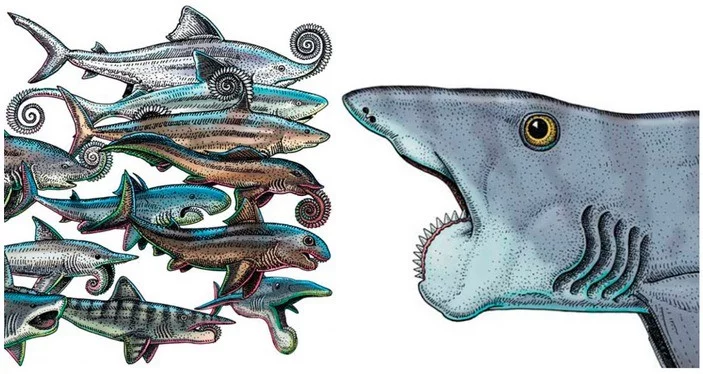
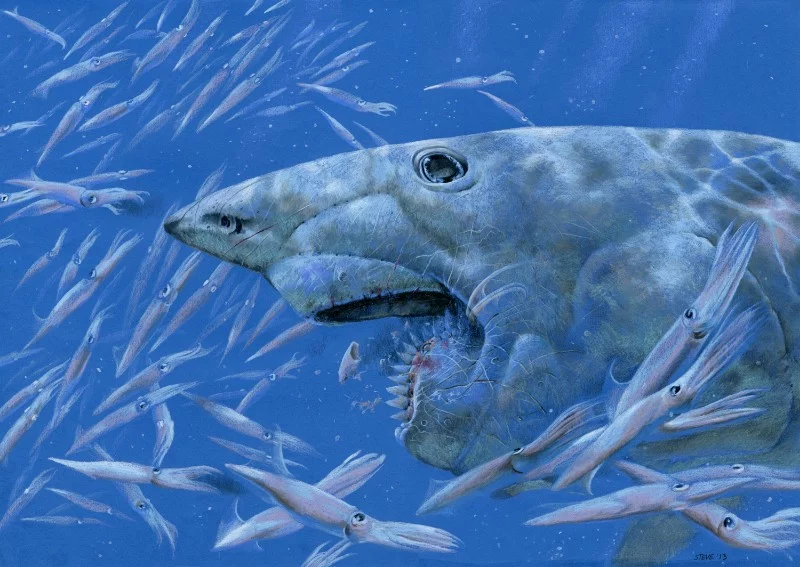
Water magazine No. 7 Helicoprion  Options for reconstructing the appearance of the Helicopter, starting from the earliest (top left — Karpinski reconstruction) to later (bottom left), the most modern reconstruction is shown on the right.  

  Options for reconstructing the appearance of the Helicopter, starting from the earliest (top left — Karpinski reconstruction) to later (bottom left), the most modern reconstruction is shown on the right.  

Tags:AnimalsAquatic creaturesKolyajivoy
3
10
13
0comments
16views

Leave a comment

Before commenting, you need to sign in.

Bestcomments (0)

There are no comments for this post yet. Want to leave the first one?

Similar posts

Water magazine No. 27 Wart

It grows up to 35cm. It lives on coral reefs, near muddy algae, in sand, rocks, mud. Due to its mottled-greenish or mottled-brown color, the stone fish easily hides, masking itself in

Water magazine No. 25 Blue angel, Sea Lily.

The blue angel is a species of gastropod mollusks common in the seas of all oceans of the tropical belt. The body length is 5-40 mm. On the sides, perpendicular to the axis of the body, there are three groups of cerata - finger-shaped

Water Magazine No. 23 Mississippian Shell

The Mississippian shellfish is one of the largest freshwater fish: according to experts, its length can reach 3 m with a weight of over 130 kg. The average life span of fish is 40 years. They have a torpedo image

Water magazine No. 22 Ordinary Catfish

Catfish belong to ray–finned fish - the first representatives of this class appeared in the Devonian period, about 390 million years BC. Previously, giant catfish were caught in European rivers for

Water Magazine No. 21 Japanese Spider Crab

The Japanese giant spider crab, although not the heaviest in the underwater world, is however the largest known arthropod. The well-calcined shell is only about 40 cm, but the total length is

Water magazine No. 20 Greenland Shark

The largest individuals can reach 7.3 m and weigh up to 1.5 tons. However, on average, the length of these sharks ranges from 2.44—4.8 m, and the weight does not exceed 400 kg. The head is elongated, the distance from the tip of the snout

Water magazine No. 19 Anomalocaris

Anomalocaris lived 520-535 million years ago. It is one of the largest predators of the Cambrian, reaching a length of up to 38 cm. Previously, it was believed that it grew up to 1 meter in length, but this estimate seems small

Water Magazine No. 18 Green Sea Turtle

The shell of a turtle is characterized by an oval shape, while its length can reach almost 2 meters, although there are mostly individuals with a shell length of no more than 1 meter. You should pay attention to

Water magazine No. 17 Krylatka

  Lionfish is a genus of ray—finned fish belonging to the scorpion family. They are distinguished by elongated feathery fins, bold patterns and extraordinary behavior. Adults reach a length of about 43 cm and a weight of

Water magazine No. 10 Beluga

The gill membranes fused together and formed a free fold under the gill gap. The snout is short, pointed, soft from above and from the sides, devoid of shields. The mouth is large, semi-lunar. Lower

Water magazine No. 8 Whale Shark

The whale shark is the largest shark species currently in existence, as well as the largest of modern fish. Its maximum size reaches at least 12.65 m, possibly more. At the whale a

Water magazine No.5 Fish penis,drop fish, Opisthoproct

Scientifically known as Urechis Caupo, or "fat tavern worm", penis fish is a type of false worm that lives under the soft sediments of the seabed. They can live up to 25 years and grow up to 30