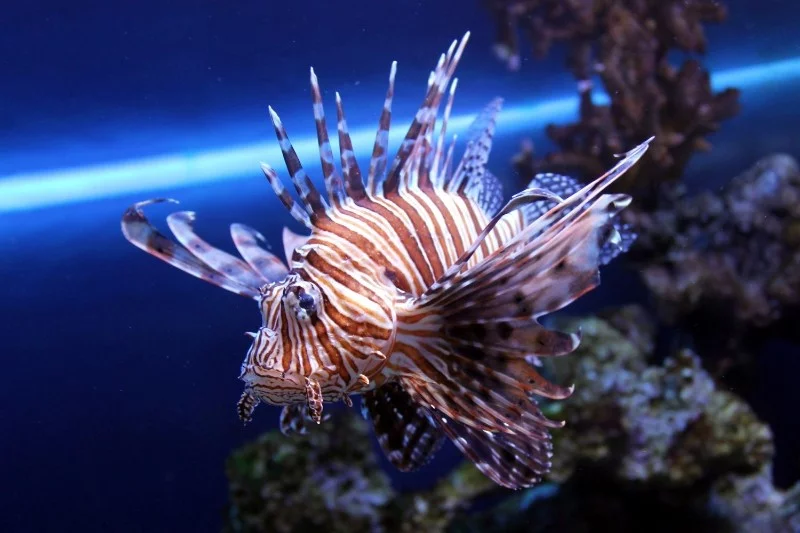
Lionfish is a genus of ray—finned fish belonging to the scorpion family. They are distinguished by elongated feathery fins, bold patterns and extraordinary behavior. Adults reach a length of about 43 cm and weigh a maximum of 1.1 kg. Like other scorpion fish, the lionfish has large feathery fins that stick out of the body, in the form of a lion's mane. Spiny protrusions on the head and venomous spikes in the dorsal, anal and pelvic fins make the fish less desirable to potential predators. Numerous fleshy protrusions on the head can mimic the growth of algae, masking the fish and its mouth from prey. Lionfish have numerous small teeth on their jaws and on the top of their mouths, which are adapted to capture and hold prey.
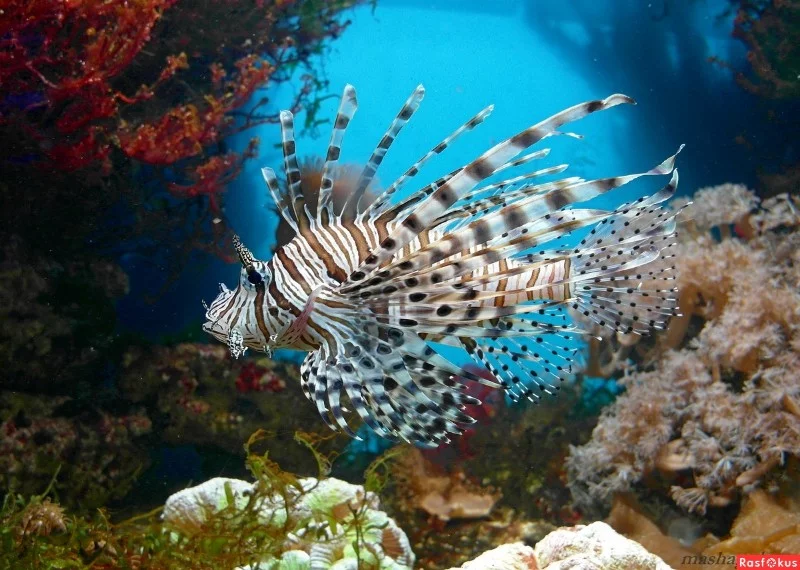
The native range of the lionfish is the western Pacific Ocean and the eastern Indian Ocean. The typical habitat of the lionfish is described as coastal coral reefs at a depth of about 50 m. However, in their natural range they also appear in shallow coastal and estuarine waters, with the highest density observed in shallower coastal waters. Large adults have been spotted at depths of 300 meters in the open ocean. The distribution of the lionfish also covers a vast territory stretching from western Australia and Malaysia east to French Polynesia and the Pitcairn Islands, from north to south Japan and south Korea and south to Lord Howe Island off the east coast of Australia and the Kermadec Islands in New Zealand. This species is found throughout Micronesia. Lionfish are mainly associated with reefs, but are also found in the warm seawater of the tropics. They tend to glide along rocks and corals during the night and hide in caves and crevices during the day.
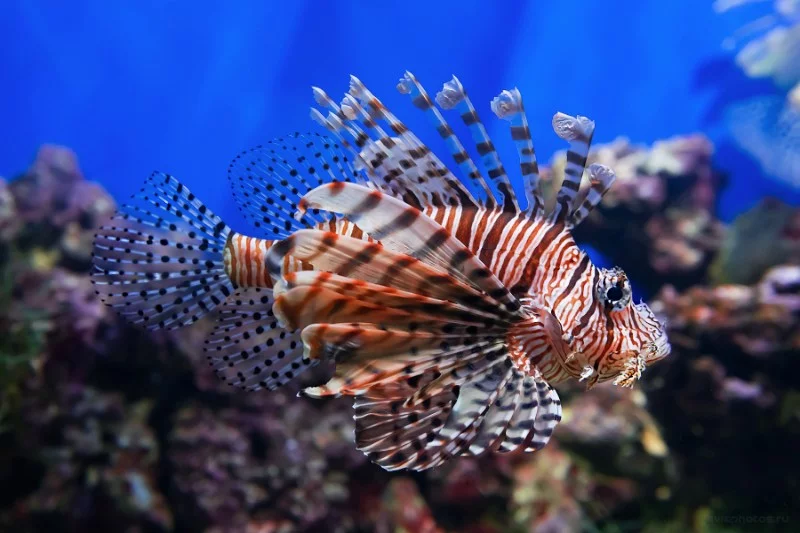
The lionfish is one of the highest levels of the food chain in many coral reef environments. They are known to feed mainly on crustaceans (as well as other invertebrates) and small fish, which include fry of their own species. Sunset is the optimal time to start feeding, because it is during this period that the activity of the coral reef becomes the highest. At sunset, the fish and invertebrates go to a night resting place, and all the nocturnal fish come out to start hunting. Lionfish do not invest much energy to overtake their prey. They just slide up the cliff, and the coral inhabitants themselves head towards the invisible predator. Moving slowly, the lionfish opens its pectoral rays to hide the movement of the caudal fin. This shielding, along with the mysterious coloring of the predator, serves as camouflage and prevents it from being detected by potential prey. Although the striped colorful pattern of the winglets is noticeable and easy to detect in an aquarium, on a coral reef this colorful pattern allows the fish to blend into a background of coral branches, feather stars and spiny sea urchins. The lionfish attacks in one swift movement and completely sucks the prey into its mouth. She also hunts near the surface of the water using various techniques. The fish waits at a depth of 20-30 cm, watching small flocks of fish jump out of the water, trying to escape from other predators. When they dive back into the water, the lionfish is ready to attack. These nocturnal fish move in the dark, slowly undulating the soft rays of the dorsal and anal fins. Although most of the feeding of the winglets is completed during the first hour of the night, they continue to be in the open space until daylight. When the sun rises, the fish retreat to secluded places among the corals and rocks. Lionfish have an amazing reproductive ability. They reach sexual maturity in less than a year and spawn year-round in warmer waters. Only during courtship does the lionfish form groups with other individuals of the species. One male unites with several females, forming groups of 3-8 fish. Females produce from 15 to 30 thousand eggs per batch, so one fish in warm waters can produce up to two million eggs per year.
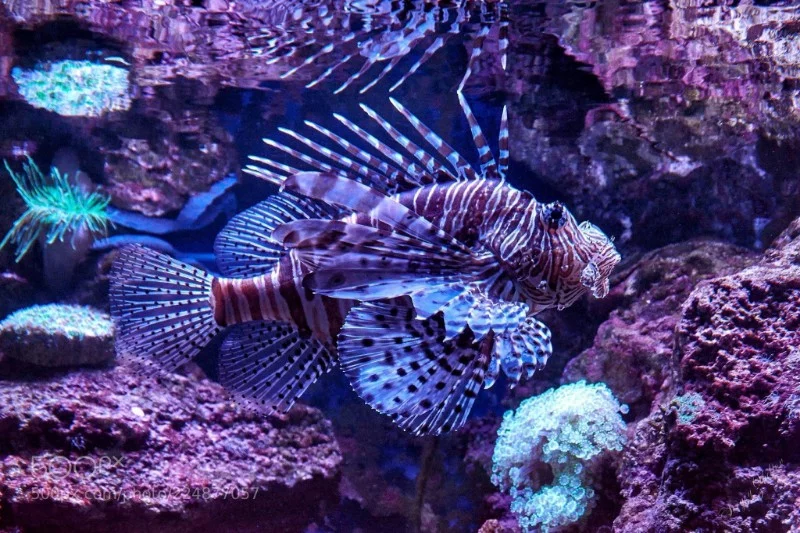
The lionfish are not currently listed as endangered. However, it is expected that increased pollution of coral reefs will lead to the death of many fish and crustaceans on which the lionfish depend. If the lionfish are unable to adapt to these changes by choosing alternative food sources, their population is also expected to decrease. It is considered an undesirable invasive species in the USA, the Bahamas and the Caribbean. It is believed that the lionfish entered the waters of the United States as a result of emissions from amateur aquariums or in the ballast waters of ships. The earliest detected cases occurred in south Florida in 1985. They spread with amazing speed along the east coast of the United States and the Persian Gulf coast, as well as throughout the Caribbean Sea. Populations of invasive winglets are increasing by about 67% per year. Field experiments have shown that lionfish can quickly displace 80% of the local fish populations on coral reefs.
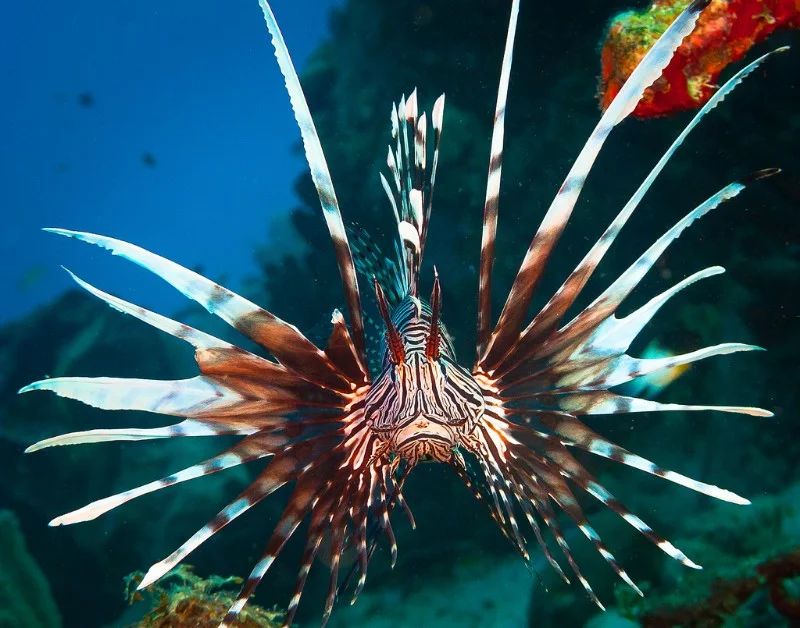
A person experiences severe pain and burning at the injection site. The poison spreads with blood flow and in some cases causes paralysis of the respiratory and skeletal muscles. There may also be seizures, pain shock, and heart failure. Now let's imagine that this happened underwater. Of course, such changes in the diver's body can lead to death, since he simply will not be able to breathe and swim out. Further, edema forms at the injection site, which can last for several days. The wound will also hurt for several days. Swelling can damage blood vessels, nerves (depending on where the lionfish stung), cause circulatory disorders and even gangrene if infection and tissue necrosis enter the wound due to prolonged edema.


Share:
Bestcomments (0)
There are no comments for this post yet. Want to leave the first one?