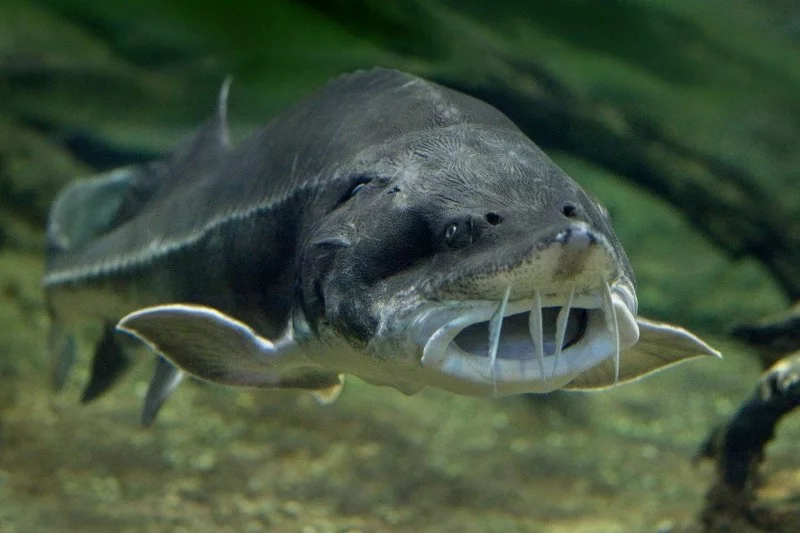
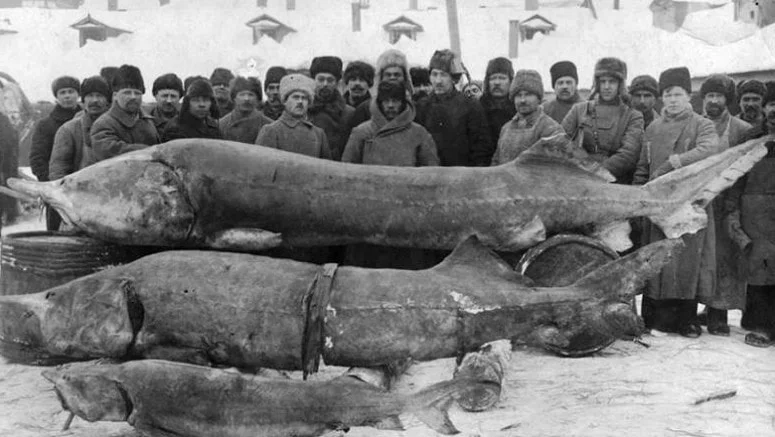
The gill membranes fused together and formed a free fold under the gill gap. The snout is short, pointed, soft from above and from the sides, devoid of shields. The mouth is large, semi-lunar. The lower lip is interrupted. The antennae are flattened laterally and equipped with leaf-like appendages. Beluga is one of the largest freshwater fish, reaching one and a half tons in weight and a length of 5 m. As an exception, individuals up to 1.5 t and 9 m in length were indicated. Now the average weight of individuals is in the range from 50 to 90 kg, and the length does not exceed 2 m. Perhaps over the past two centuries, man has been so diligently engaged in catching beluga for the sake of black caviar that the fish does not physically have time to grow to large sizes.
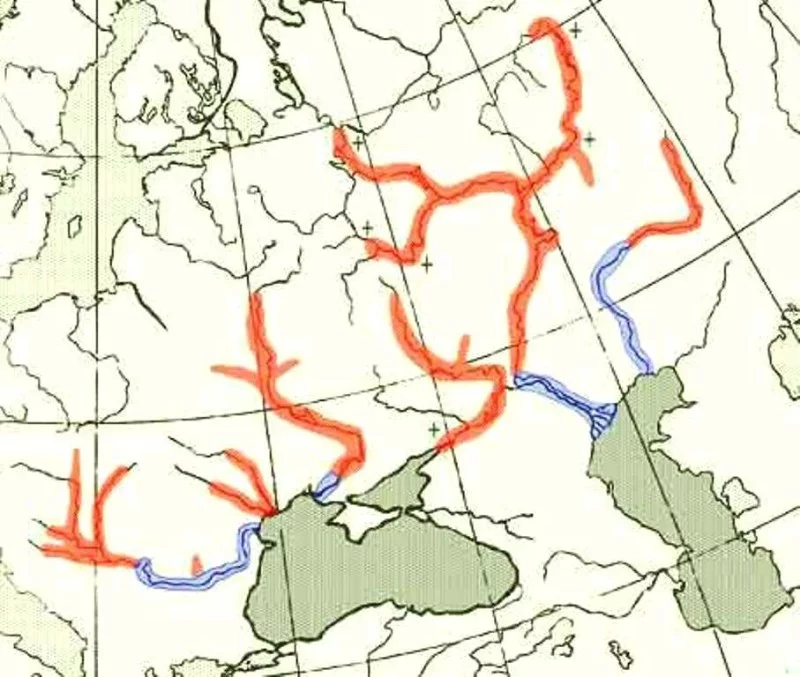
A passing fish found in the Caspian, Azov and Black Seas, from where it enters rivers for spawning. Until the beginning of the 20th century, beluga was relatively numerous, but now it is on the verge of extinction in the wild. It was widespread in the Caspian Sea. Currently, it enters mainly the Volga River for spawning, in much smaller quantities — in Ural and Kuru, as well as Terek. In the past, spawning fish climbed the pool The Volga is very high — up to Tver and up to the upper reaches of the Kama River. These fish are very picky about the surrounding conditions, so they choose only clean waters for living. Because of this, their habitat has been greatly reduced in recent decades due to the emergence of new hydroelectric power plants.If a female swims into polluted waters, she refuses to spawn, and the pre-formed eggs simply dissolve. The beluga is constantly changing its habitat, migrating thousands of kilometers across the water. She usually swims at great depths, where she searches for food. But in warm weather it can rise to the surface. Previously, beluga whales could be found in the Adriatic Sea, but for the last 50 years this species of sturgeon has not been seen by humans.
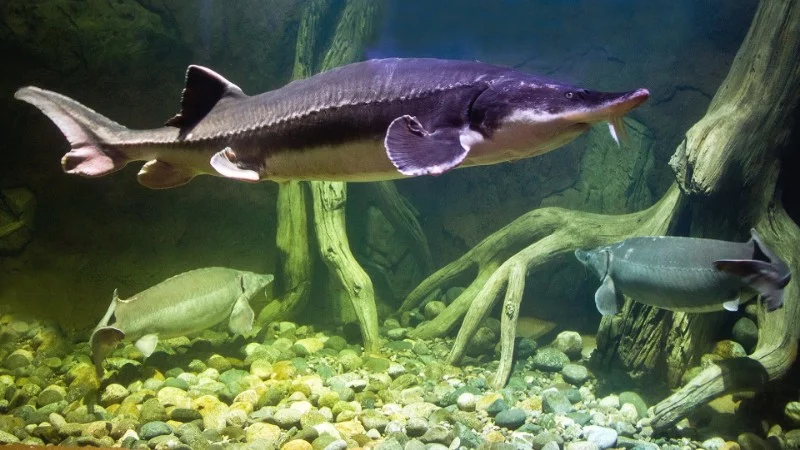
Beluga is a long—lived fish, reaching the age of 100 years. The caviar is bottom, sticky. Fry appear in the Volga Delta in June, their length is 1.5—2.4 cm. They quickly slide into the Caspian Sea as fry, but single specimens can linger in the river up to 5-6 years of age. Caspian beluga males reach sexual maturity at 13-18 years old, and females at 16-27 (mainly at 22-27) years old[11]. The fertility of the beluga, depending on the size of the female, ranges from 500 thousand to a million (in exceptional cases — up to 5 million) eggs. Beluga spends most of his life at the bottom. The fish is on the move all the time, trying to find food. Its habitat depends on the time of year. In summer, she chooses shallow crevices, and with the onset of cold weather, she looks for places with greater depth. Because the fish is large, none of the marine predators hunt it. In case of danger, the beluga is able to cope with any opponent, and all the creatures around it understand this. However, young individuals cannot feel completely safe. Fry and caviar often become food for any meat-eating fish.
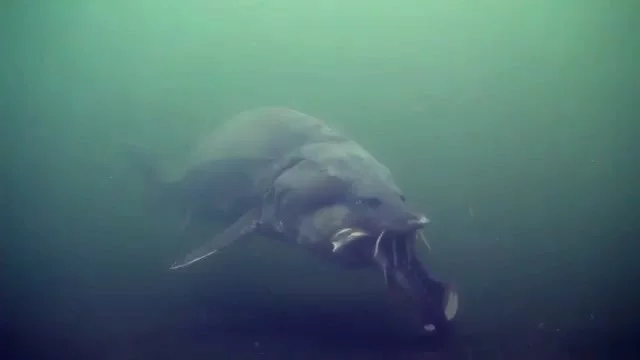
An adult beluga eating another smaller sturgeon.
In the past, it was a valuable commercial fish. Beluga fishing has been banned in Russia since 2000, and an international moratorium has been in effect since 2016, prohibiting the fishing of beluga (and other sturgeon species) in all Caspian countries. Meat, caviar, insides, skin, and heads are used. The number of the Azov beluga has sharply decreased due to the complete loss of natural spawning grounds, as a result of hydraulic engineering, a small number of spawning populations, low efficiency of artificial reproduction due to a shortage of producers, overfishing both in rivers and in the sea, which was carried out until the mid-80s. Beluga is listed in the Red Book as an endangered species. Special reservoirs are regularly built where beluga is artificially grown in order to increase its population. However, it is not always possible to achieve the desired result, because the fish is very fastidious to the surrounding conditions. In order to reduce the desire of poachers for the extraction of black caviar, laws were passed in Russia prohibiting the capture of beluga whales. Now this activity is criminally punishable and can result in a large fine or up to five years. For 100 grams of caviar, you will need to pay about 15 thousand rubles. During spawning, females lay black caviar, and its mass is 20-25% of the body weight. Its number is constantly decreasing, despite the fact that females produce up to a million eggs at a time. The main problem of fish is related to the fact that it reaches puberty at too late an age, which most individuals do not live up to.


Share:
Bestcomments (0)
There are no comments for this post yet. Want to leave the first one?