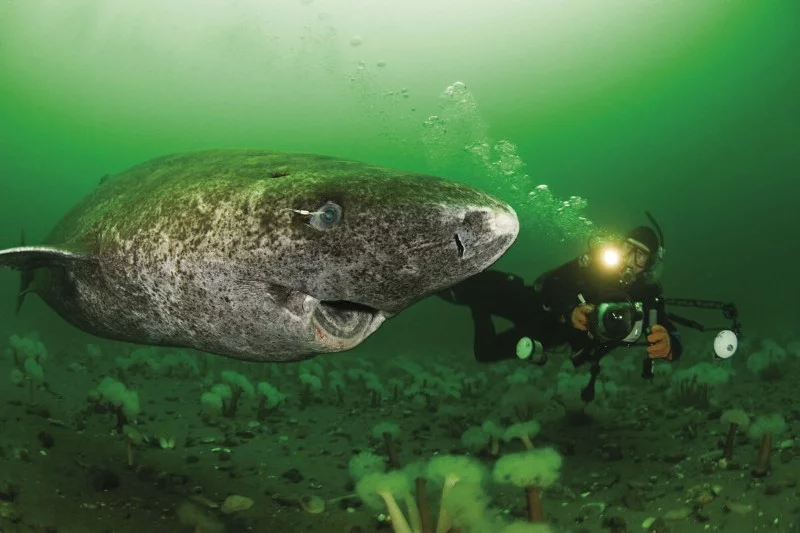
The largest individuals can reach 7.3 m and weigh up to 1.5 tons. However, on average, the length of these sharks ranges from 2.44—4.8 m, and the weight does not exceed 400 kg. The head is elongated, the distance from the tip of the snout to the pectoral fins of a 2.99 m long shark was 23% of the total size. The snout is short and rounded. The massive body has the shape of a cylinder. Fins are visually distinguished on its body to a much lesser extent than in most sharks, since their size is relatively small. In general, they are relatively poorly developed, as is the tail stalk, and therefore the Greenland shark does not differ at all in speed. The gill slits are very small for a shark of this size. The color ranges from pale gray-cream to black-brown. Feeding on large carcasses, the shark uses rotational movements of its jaws. 48-52 teeth of the upper jaw are very thin and pointed, without notches. These teeth of the upper jaw act as an anchor, while the lower jaw continues to cut massive chunks from prey for a quick and easy meal.
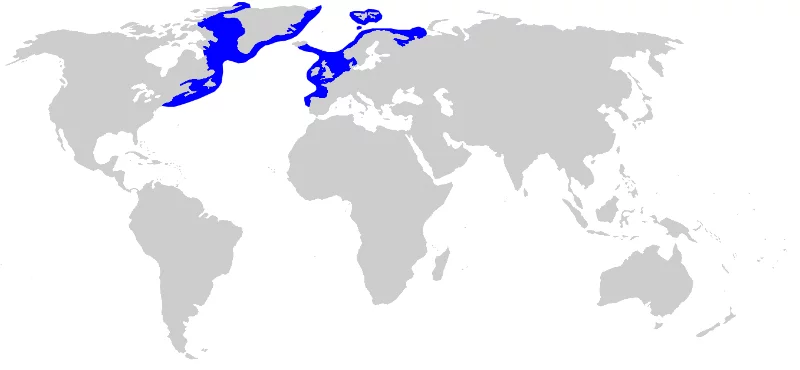
They live exclusively in Arctic, ice–bound seas - north of any other shark. The explanation is simple: the Greenland shark is very fond of cold and, once in a warmer sea, quickly dies, because its body is adapted exclusively to cold water. The preferred water temperature for it is in the range from 0.5 to 12 °C. Its main habitat includes the seas of the Atlantic and Arctic Oceans. Most often they can be found on the shelf, near the coast of the mainland or islands, but sometimes they can swim far into the ocean waters, to a depth of up to 2,200 meters. But usually they do not descend to such extreme depths – in summer they swim several hundred meters below the surface. In winter, they move closer to the shore, at this time they can be found in the surf zone or even at the mouth of the river, in shallow water.
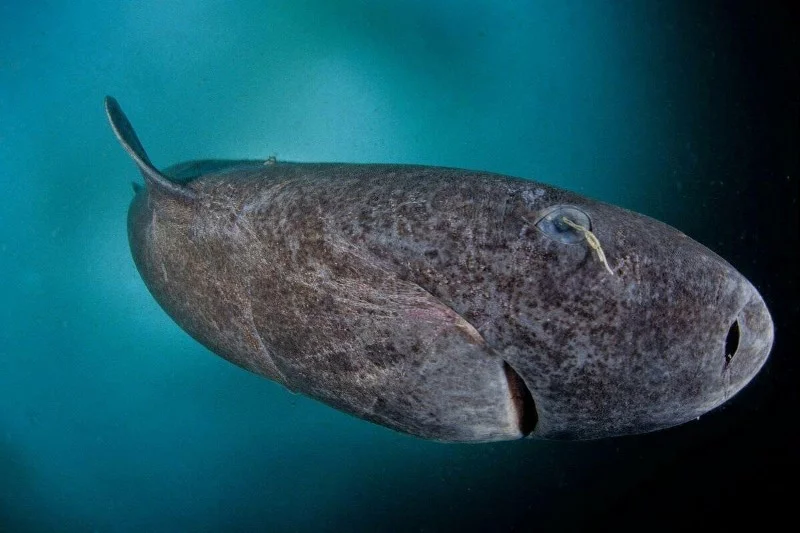
It is unable to develop not only high, but even average speed: its limit is 2.7 km/ h, which is slower than any other fish. And it's still fast for her – she can't keep such a "high" speed for a long time, but usually develops 1-1.8 km/ h. With such high-speed qualities, she can't keep up with her prey at sea. Nevertheless, the Greenland shark feeds on animals faster than itself – it is very difficult to catch it, and if you compare by weight how much prey a Greenland shark can catch and some faster one living in warm seas, the result will differ at times, or even by orders of magnitude – naturally, not in the benefit of Greenland. And yet, even a modest catch is enough for her, since her appetite is also orders of magnitude lower than that of faster sharks of the same weight – this is due to the same factor of slow metabolism. They do not have good hearing, but they have an excellent sense of smell, which they mainly rely on in search of food – it is quite difficult to call it hunting. A significant part of the day is spent in this search. The rest of the time is devoted to rest, because they can't waste a lot of energy. The basis of the Greenland shark's diet: fish, rays, eels, marine mammals. It lies in wait for marine mammals sleeping. This is the only way a Greenland shark can get close to them. It can eat and fell, so the remains of deer and bears were found in the stomachs of captured individuals. If ordinary sharks swim to the smell of blood, then Greenland sharks are attracted to rotting meat, because of which they sometimes follow fishing vessels in whole groups and devour the animals that are thrown away from them.
The most notable feature of this shark is longevity. Of those individuals whose age has been clarified, the oldest is 512 years old. This makes it the oldest living vertebrate. All representatives of this species, unless they die from wounds or diseases, are able to live to the age of several hundred years. Scientists explain the longevity of Greenland sharks primarily by the fact that they live in a cold environment – their metabolism is greatly slowed down in their body, and therefore tissues are preserved much longer. One Greenland shark was spotted off the coast of Greenland in 1936 and caught in 1952. His measurements show that Greenland sharks grow at a rate of 0.5–1 cm (0.2–0.4 inches) per year.
The years go very differently for them – much more imperceptibly than for people, because all the processes in their body proceed very slowly. Therefore, they reach sexual maturity by about the age of one and a half centuries: by that time, males grow to an average of 3 meters, and females reach one and a half times the size. The time for reproduction comes in the summer, after fertilization, the female bears several hundred eggs, and an average of 8-12 fully developed sharks are born, already reaching impressive sizes at birth – about 90 centimeters. The female leaves them immediately after giving birth and does not care in any way.
Adult sharks have few enemies: of the large predators, killer whales are mainly found in cold seas. The researchers found that although other fish predominate in the menu of killer whales, Greenland sharks may also be included in it. They are inferior to killer whales in size and speed, and are practically unable to oppose them. Thus, they turn out to be easy prey, but how much their meat attracts killer whales has not been reliably established – because it is soaked in urea, and is harmful to both humans and many animals. Of the other predators of the northern seas, adult Greenland sharks are not threatened by anyone. Most of them die because of humans, even despite the lack of active fishing. There is an opinion among fishermen that they devour fish from gear and spoil them, because some of the fishermen, if they come across such prey, chop off its tail fin, after which they throw it back into the sea – naturally, it dies. They are plagued by parasites, and most of all by vermiform ones that penetrate into the eyes. They gradually eat the contents of the eyeball, which causes vision to deteriorate, and sometimes the fish goes blind altogether. Oar–footed luminous crustaceans may live around their eyes - their presence is indicated by greenish luminescence.
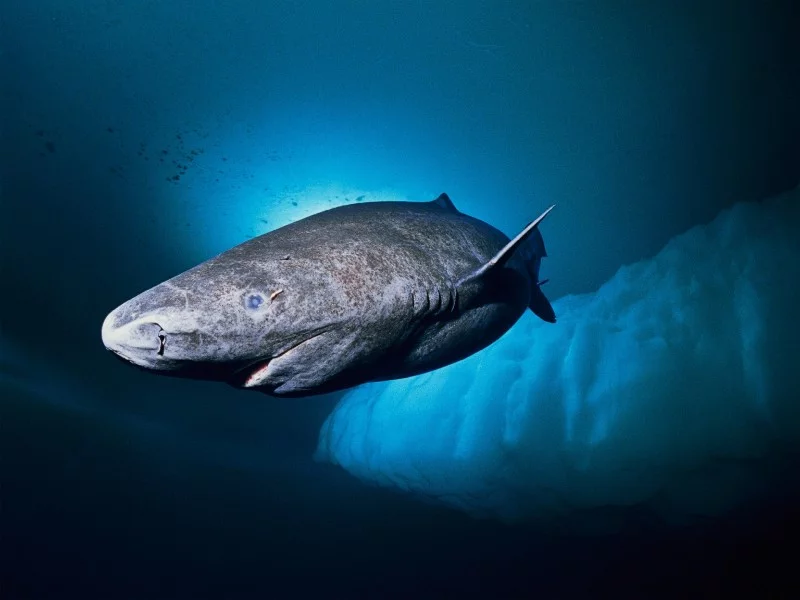
They are not listed as endangered species, but they cannot be called prosperous either – they have the status of being close to vulnerable. This is due to the relatively low population level, which is gradually falling even though the commercial value of this fish is low. But still, it is there – first of all, the fat of their liver is appreciated. This organ is very large, its mass can reach 20% of the total body weight of a shark. Its raw meat is poisonous, it leads to food poisoning, convulsions, and in some cases, death. But with prolonged processing, it can be made into haukarl and eaten. Due to the valuable liver and the ability to use meat, the Greenland shark used to be actively caught in Iceland and Greenland, because the choice there was not too wide. But in the last half century, there has been almost no fishing, and it comes across mainly as by-catch. Sport fishing, which many sharks suffer from, is also not practiced in its relation: there is little interest in fishing it because of its slowness and sluggishness, it does not offer practically any resistance. Fishing for it is compared to fishing for a log, which, of course, has little excitement.


Share:
Bestcomments (0)
There are no comments for this post yet. Want to leave the first one?