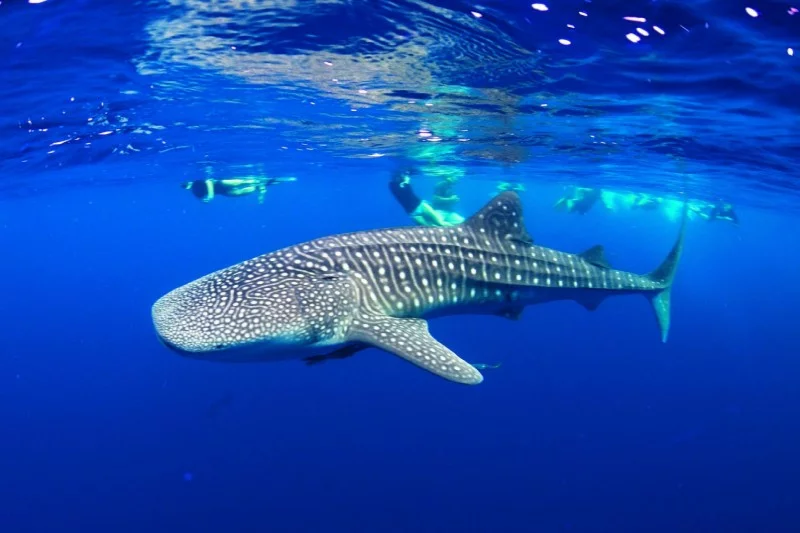
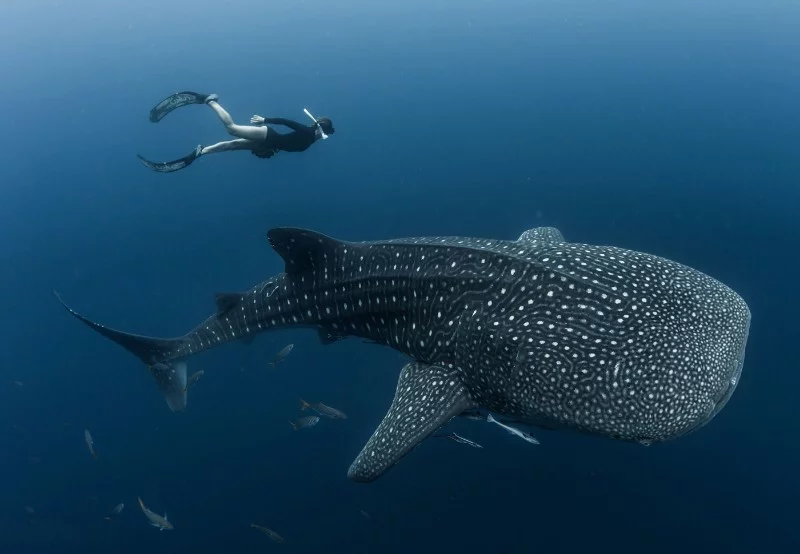
The whale shark is the largest shark species currently in existence, as well as the largest of modern fish. Its maximum size reaches at least 12.65 m, possibly more. The whale shark has a powerful and thick body, and a relatively small head. The shape of the head is very peculiar — it is strongly flattened, and it becomes more and more flat towards the end of the snout. The mouth can open very strongly and at full swing takes on the appearance of a wide oval. The number of teeth in a whale shark is extremely large and can reach several thousand. The shark, which had 3,000 teeth in its mouth, had about 300 rows on each jaw. The teeth are small, even in the largest sharks not exceeding 6 mm in length. For decades, reports of whale sharks up to 20 m long have remained unverified. However, in the late 1990s, scientific information appeared about a whale shark 20 m long and weighing 34 tons (the weight of an average sperm whale). Therefore, in modern sources, the length of a whale shark of 20 m is already indicated as fully verified[8]. In a number of sources, data on sightings of whale sharks even with a length of 21.4 m appear, but in general, specimens larger than 12 m are extremely rare.
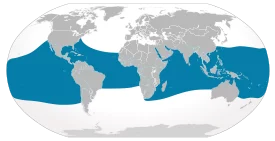
The area of the whale shark
Despite the fact that the whale shark is found in the warm waters of the world ocean almost everywhere, in some areas it is more numerous. Whale sharks are most often found, in particular, near Taiwan and the Seychelles, where they stay all year round, although their peak numbers in these waters are observed in June — August and October — November. Increased numbers of whale sharks have been noted off the coast East and South-East Africa, where population fluctuations are also seasonal. It is known that whale sharks make very distant migrations. One of the sharks tagged off northeastern Australia moved 1,800 km to Indonesian waters in 35 days.
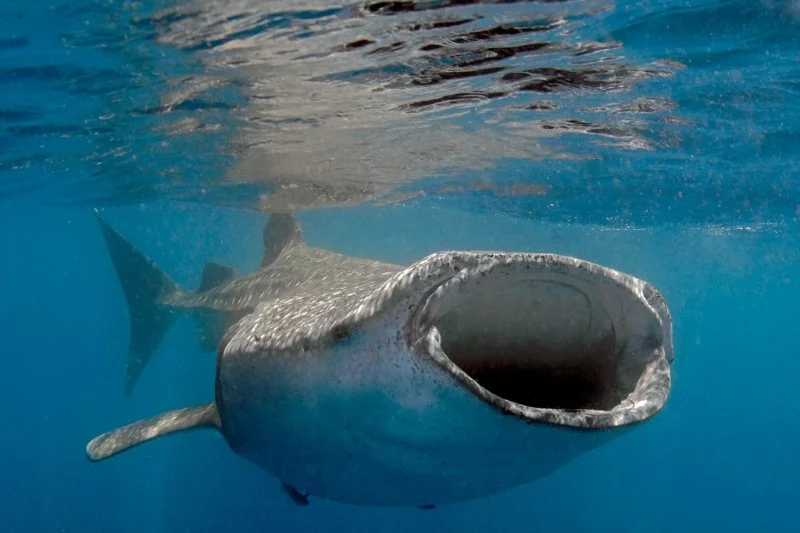
The whale shark's feeding method is similar to that of baleen whales, which also feed on plankton. However, if baleen whales filter water with food through the plates of whalebone growing from the palate of the upper jaw, then the filter apparatus of a whale shark consists of 20 cartilaginous plates connecting individual gill arches to each other like a lattice (the side of its jaws is only 1-3 mm), and on which skin teeth are located. The whale shark is capable of feeding up to 6 thousand cubic meters of water per hour through its mouth. After collecting water with plankton in its mouth, the shark closes it, after which the water is filtered through the gill openings. Then the filtered forage organisms enter the stomach through a narrow (no more than 10 cm in diameter) esophagus. It is in connection with this way of feeding that the teeth of the whale shark are very small and numerous; they do not serve for biting, but for "locking" prey in the mouth. When feeding, the shark moves very slowly — about 1 m / s, and often almost stops, hovering in the water, and, sucking in plankton, sways up and down, moving its head to the sides. Often, the fish stays almost vertically to the surface. According to most descriptions, the whale shark is characterized by exceptional apathy and slowness. The fish prefers to stay in the near-surface layer of water, usually no deeper than 70 m. During deep dives, the whale shark, according to the data obtained during tagging, can descend to a depth of 700 m, where the water temperature is about 7 °C. The whale shark is obviously active around the clock and sleeps for short periods regardless of the time of day. The plankton-eating whale shark is generally considered to pose absolutely no threat to humans. In some countries where whale sharks are relatively common, the organization of whale shark watching tours is becoming an increasingly important branch of the tourism business. During such tours, shark sightings are carried out both from ships and boats, and during scuba diving.
There have been practically no calculations of the number of whale sharks, so there is no accurate data on their population. In any case, whale sharks have never been numerous in the past. There is evidence that there are only about 1 thousand whale sharks left on the whole Earth — if this information is correct, then the whale shark is one of the rarest fish in general and is on the verge of extinction. Some sources, however, report that this figure applies only to those specific individuals that scientists manage to track. Since the mid-1990s, a number of States have banned the fishing of whale sharks. Since 2016, the whale shark has been listed as an endangered species. The main threat to the whale shark population is considered to be their commercial fishing. Despite the protection measures taken, whale shark fishing in tropical countries continues due to population growth and, consequently, the growing need for protein food. This is one of the main reasons for the decline in the whale shark population in the Pacific and Indian Oceans. Exceptionally long maturation and a slow rate of reproduction prevent the rapid recovery of livestock. The natural decline of the whale shark population is 5-6% per year. Even an adult whale shark has virtually no means of self-defense, but the huge size of this fish, combined with its exceptionally thick and durable skin, dramatically reduces the number of likely predators that could attack it[28]. However, juveniles can become prey to predators. However, only a few such cases are reliably known. There were also reports of an attack by killer whales that mauled an 8-meter whale shark. Scars were described on the body of adult sharks, which could be marks from the teeth of killer whales. However, according to some reports, the whale shark has an exceptionally high ability to recover from severe wounds that heal very quickly — a case has been described when a whale shark received two serious wounds on its belly, inflicted, apparently, by large predatory sharks. Two years later, this shark didn't even have any scars.
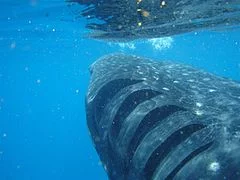
The gills of a grazing whale shark, allowing a large volume of water to pass through

A 13.5-meter whale shark caught off Florida (1912 photo)
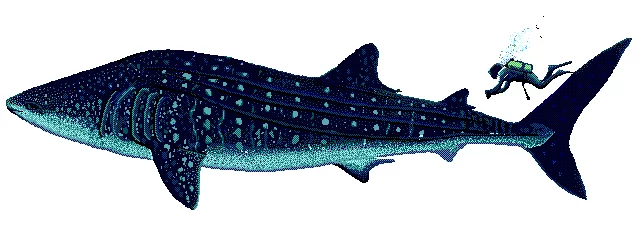
A whale shark compared to a diver


Share:
Bestcomments (0)
There are no comments for this post yet. Want to leave the first one?