Scroll to top

Vodniy Jurnal

kolyajivoy

Water magazine No. 27 Wart

Water magazine No. 27 Wart

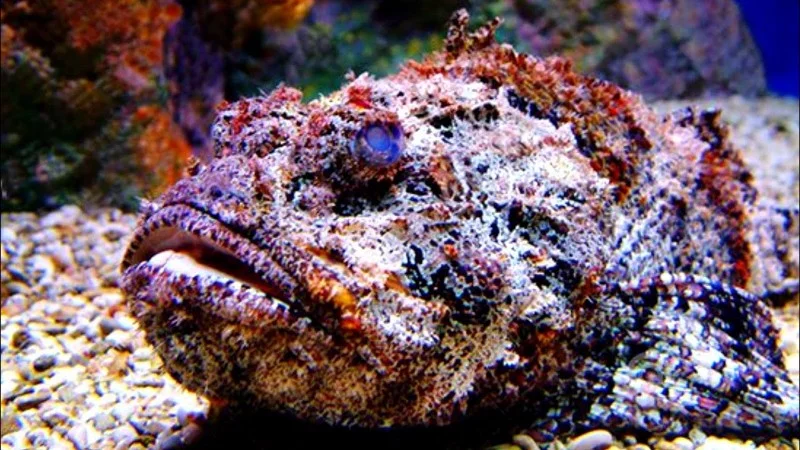
It grows up to 35cm. It lives on coral reefs, near muddy algae, in sand, rocks, mud. Due to its mottled greenish or mottled brown color, the stone fish easily hides, masking itself in tropical reefs and algae. She leads a sedentary lifestyle, in shallow water near the shore, in crevices of coral reefs. Most often, he just lies buried in a crevice of a stone or in the sand. Only the upper part of the head and part of the back are visible. Sand and small algae stick to it. That's how she disguises herself and hunts. The dorsal fin consists of 12-14 thick spines. The thorns contain glands that produce venom. The basis of the diet are small fish, shrimp, crustaceans.

The area

It is found in: south tropical areas, shallow waters of the Pacific and Indian Oceans. In the waters and basin of the Red Sea, on the coasts and in the deep waters of the Great Barrier Reef, in the waters of Australia, Indonesia, the waters and basin of the Red Sea, the Philippine Islands, etc.

Poison

На 3:15 видно, как рыба пускает яд

For a person, its poison is dangerous, it can become a threat to the health and life of the victims. There are thorns in the dorsal fins, they are prickly, and a poisonous toxic substance is produced inside. It is the most dangerous among all other species of poisonous fish. Her injection is very painful, after which the injured person experiences severe pain, which can be supplemented by shock. Paralysis and rapid tissue necrosis may also occur. If a person steps on the sharp poisonous thorns of a wart, he needs timely help. Otherwise, the injection may be fatal, such an outcome occurs after a few hours. If the toxic substance penetrates immediately into the blood artery, it is fraught with death after a couple of hours. Toxins can be eliminated from the body for up to several months, even if timely medical care is provided. The basis of the poison are proteins and neurotoxins. The only method of treating a wart injection is a special therapeutic antidote serum.

Tags:Aquatic creaturesKolyajivoy
3
11
14
0comments
11views

Leave a comment

Before commenting, you need to sign in.

Bestcomments (0)

There are no comments for this post yet. Want to leave the first one?

Similar posts

Water magazine No. 25 Blue angel, Sea Lily.

The blue angel is a species of gastropod mollusks common in the seas of all oceans of the tropical belt. The body length is 5-40 mm. On the sides, perpendicular to the axis of the body, there are three groups of cerata - finger-shaped

Water Magazine No. 23 Mississippian Shell

The Mississippian shellfish is one of the largest freshwater fish: according to experts, its length can reach 3 m with a weight of over 130 kg. The average life span of fish is 40 years. They have a torpedo image

Water magazine No. 22 Ordinary Catfish

Catfish belong to ray–finned fish - the first representatives of this class appeared in the Devonian period, about 390 million years BC. Previously, giant catfish were caught in European rivers for

Water Magazine No. 21 Japanese Spider Crab

The Japanese giant spider crab, although not the heaviest in the underwater world, is however the largest known arthropod. The well-calcined shell is only about 40 cm, but the total length is

Water magazine No. 20 Greenland Shark

The largest individuals can reach 7.3 m and weigh up to 1.5 tons. However, on average, the length of these sharks ranges from 2.44—4.8 m, and the weight does not exceed 400 kg. The head is elongated, the distance from the tip of the snout

Water magazine No. 19 Anomalocaris

Anomalocaris lived 520-535 million years ago. It is one of the largest predators of the Cambrian, reaching a length of up to 38 cm. Previously, it was believed that it grew up to 1 meter in length, but this estimate seems small

Water Magazine No. 18 Green Sea Turtle

The shell of a turtle is characterized by an oval shape, while its length can reach almost 2 meters, although there are mostly individuals with a shell length of no more than 1 meter. You should pay attention to

Water magazine No. 17 Krylatka

  Lionfish is a genus of ray—finned fish belonging to the scorpion family. They are distinguished by elongated feathery fins, bold patterns and extraordinary behavior. Adults reach a length of about 43 cm and a weight of

Water magazine No. 10 Beluga

The gill membranes fused together and formed a free fold under the gill gap. The snout is short, pointed, soft from above and from the sides, devoid of shields. The mouth is large, semi-lunar. Lower

Water magazine No. 8 Whale Shark

The whale shark is the largest shark species currently in existence, as well as the largest of modern fish. Its maximum size reaches at least 12.65 m, possibly more. At the whale a

Water magazine No.5 Fish penis,drop fish, Opisthoproct

Scientifically known as Urechis Caupo, or "fat tavern worm", penis fish is a type of false worm that lives under the soft sediments of the seabed. They can live up to 25 years and grow up to 30

Water magazine No. 3 Som Kandiru, Lamprey

Its thin and skinny, so it is almost transparent. Hungry, kandiru begins to search for a victim — and he is looking for some bigger fish. To find her, even in the murky opaque waters of the Amazon