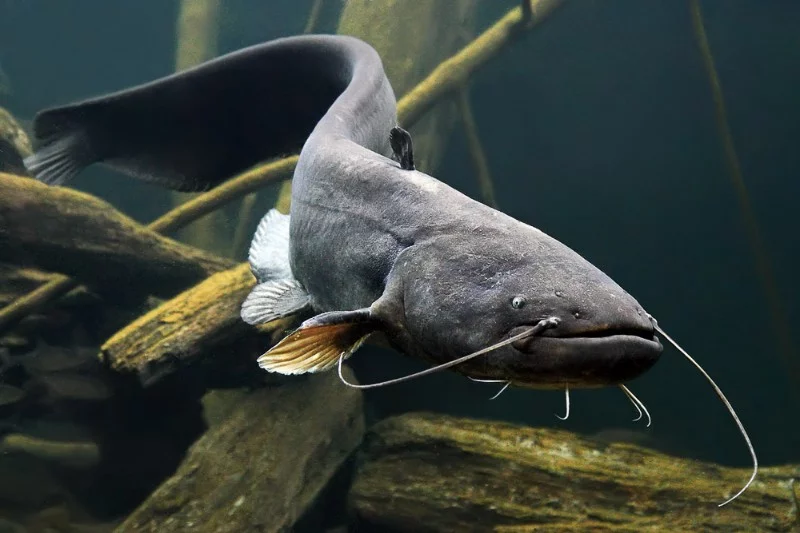
Catfish belong to ray–finned fish - the first representatives of this class appeared in the Devonian period, about 390 million years BC. Previously, giant catfish were caught in European rivers – their body length was up to 5 meters, and their weight was up to 400 kilograms. These data are credible, since the largest of the individuals designed according to all the rules is only slightly inferior – its weight turned out to be 306 kg. However, catfish grow all their lives, which means that they reach such sizes very rarely: in recent decades, individuals heavier than 160 kg have not been caught – and even this weight is already huge for catfish. An adult fish is considered to weigh from 12-15 kg, and individuals heavier than 30 kg are very rare – this is a great success for the angler. The head of the catfish is large relative to the body and looks like it is flattened. The jaws are massive, but the teeth are very small – but there are a lot of them, and they are sharp. A characteristic sign of a catfish is a mustache, two long and four short ones. Whiskers are very important for the catfish, he uses them to look for prey – even in complete darkness, with their help, the catfish senses its approach. In addition, they can act as bait – hiding, he exposes them and lures small fish that mistake them for prey. The body of the catfish has a rounded shape in front, but the further to the tail, the more it contracts. The tail is very strong and long – about half the entire length of the fish, the fins are generally quite powerful, but because of their size, catfish are inferior to most other fish in speed and maneuverability. There are no scales, instead their skin is protected by a lot of mucus.

Red is a natural area (freshwater reservoirs), Orange is introduced (freshwater reservoirs), blue is an area in salty reservoirs
It is found in most of the Europe, including the entire European Russia. Catfish are very fond of large, deep rivers and reach especially large sizes in them, they prefer warm waters. Common catfish live at the very bottom of the reservoir, they usually find a quiet place – a pit between driftwood, and settle there. They do not sail far from their favorite pit even during hunting, but spend a significant part of their time right there. They rarely change their habitat, and may even spend their whole lives in one place. A lack of nutrition may prompt a change – then the catfish swims to where there will be more prey, or turbidity of the water – they are very picky about its purity. Therefore, if the water becomes cloudy during floods, the catfish can go in search of a new place to live.
The catfish diet includes: fish, birds, shellfish, insects, fry, larvae, worms, vegetation.
They often eat carrion, which is why there is a common misconception that they are limited to it - it is due to the fact that this big fish looks slow and unwieldy. But she is more nimble than it might seem and, although carrion actually makes up a significant part of the menu, but catfish are not averse to eating live animals. So, they hunt a variety of fish – they can swim right into shoals of small fish and, opening their mouths wide, eat dozens of them at once, or hunt large ones like bream or walleye. They can also dine on large amphibians like frogs, newts or waterfowl – although they are rarely caught. They can catch and eat pets trapped in the water – cats or small dogs. There are even cases of attacks on calves caught in the water and, moreover, on people. It is difficult to say whether catfish is really dangerous for humans, it is only reliably known about people bitten by them who accidentally stepped on their nest. Legends about man-eating catfish are associated with the finds of human bones in the stomachs of giant individuals, as well as rings and pieces of clothing. Most likely, the catfish simply ate the already dead bodies that ended up in the river – there are no reliably recorded cases of people being killed by them. They hunt mainly at night, while they can both look for prey at the very bottom and rise to the surface, where small fish can be found. They remember where the old net is left, and constantly check it to see if the fish is entangled there. They stand out for their voracity: even taking into account their size, they eat a lot.
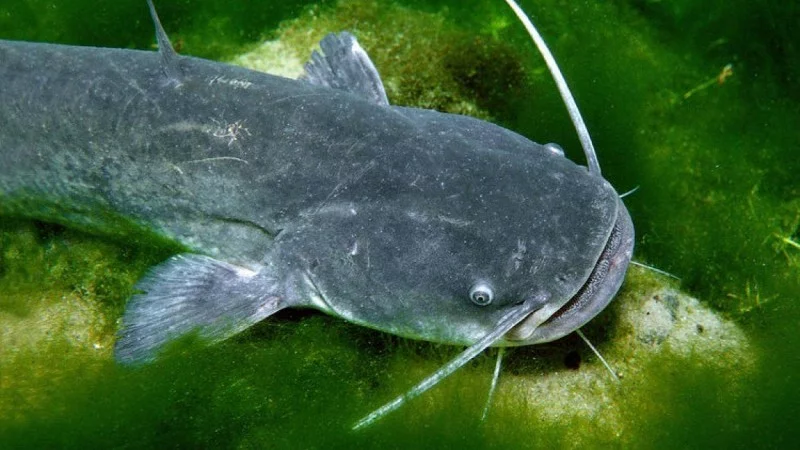
Catfish are homebodies and loners – they live for a long time in a quiet pit they like and do not want anyone to let them near it. But this applies to adults – as the fry keep in flocks, so the already slightly grown catfish remain in them for the first years of life. They love warm and clean water. When it rains heavily and the water gets cloudy, they get out of the lair and stay near the surface, where it is cleaner. In winter, their activity subsides: they gather in flocks of 5-10 individuals and lie down in wintering pits. They feed very rarely at this time, spending most of their time motionless, falling into a kind of hibernation. Catfish live for quite a long time – 30-60 years, and the oldest and largest caught specimens were 70-80 years old. With age, the catfish becomes slower, while it needs more and more food, instead of actively hunting, it begins to simply swim with its mouth open, trying to suck in living creatures – it spends more and more time on food and it becomes more difficult for it to feed itself. Catfish reproduce quite efficiently. This is shown by the practice of launching them into rivers where they were not found before: if the habitat suits them, then a small population of catfish grows strongly after only a few decades, and after 50-70 years there is no difference with those rivers where they were historically found – there are just as many of them in the new ones. After spawning, the female swims away – she is no longer interested in the fate of her offspring, and all worries remain with the male. He is almost constantly at the nest and is engaged in the protection of eggs, and also constantly brings fresh water saturated with oxygen to the nest – this is necessary for the better development of offspring.
The only enemy of adult catfish is humans. No river fish is able to match their size and even more so does not attack them, so they live quite freely in the water and suffer only from human activity.Even young catfish are not threatened by anyone except humans. Other predatory fish can only be a threat to them while they are still very young. The species is not in danger, and its population in European rivers is very large. This is a fish that is actively hunted, because its meat has high taste qualities, it is tender and fatty. Due to too intensive fishing during the 20th century, a decrease in the number of catfish was noted in the rivers of Russia, but so far it is not critical. Catfish catches in the whole country have dropped significantly. But, as European practice shows, if you stop catching this fish too actively, it will multiply quickly.
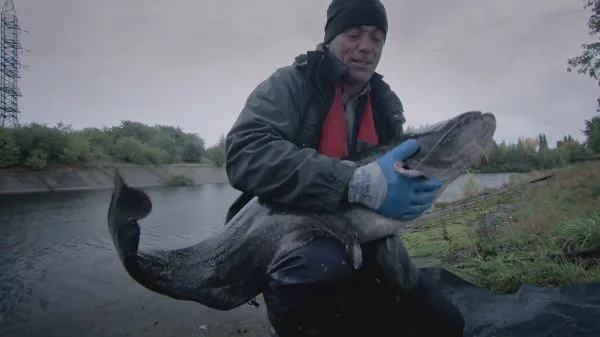
Catfish caught in Chernobyl


Share:
Bestcomments (0)
There are no comments for this post yet. Want to leave the first one?