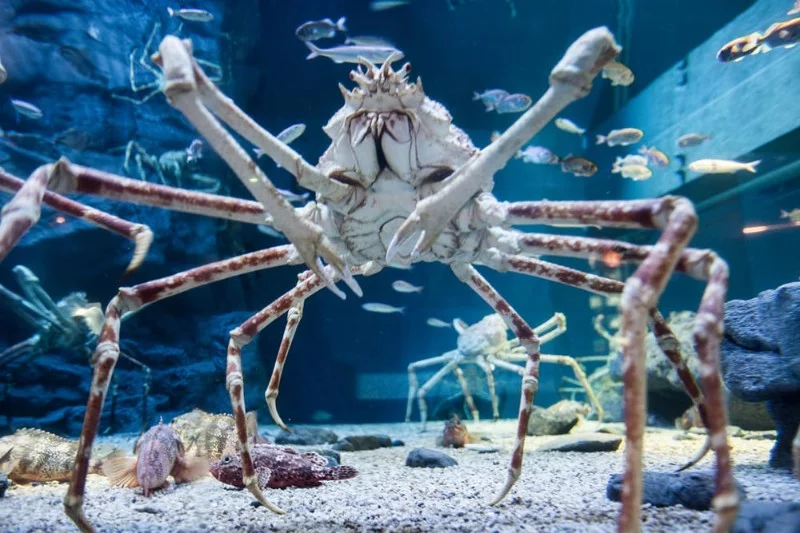
The Japanese giant spider crab, although not the heaviest in the underwater world, is however the largest known arthropod. A well-calcined shell is only about 40 cm, but the total length of adult individuals can be almost 5 meters from one tip of the cheliped (claws with claws) to the other when stretched. The whole crab weighs up to 19 kg. Spiny and short tubercles (growths) cover the carapace, which varies from dark orange to light brown in color. The shell tends to remain the same size throughout adulthood, but the claws lengthen significantly as the age of the crab increases. Spider crabs are known for having long, thin limbs. The walking claws end with moving parts curved inwards at the tip of the walking limb. Although long legs, they are often weak. One study reported that almost three quarters of these crabs lack at least one limb, most often one of the first walking legs. This is because the limbs are long and poorly connected to the body and tend to come off due to predators and nets. Spider crabs can survive if up to 3 walking legs are missing. Walking legs can grow back during regular molts.
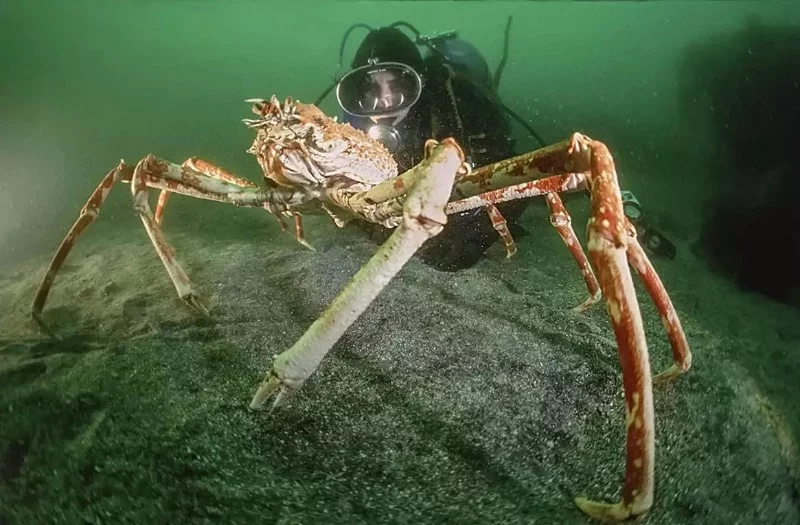
The habitat of the Japanese arthropod giant is limited to the Pacific side of the Japanese Honshu Islands from Tokyo Bay to Kagoshima Prefecture, usually at a latitude of 30 to 40 degrees north latitude. Japanese spider crabs most often live on the sandy and rocky bottom of the continental shelf at depths up to 300 meters. They like to hide in vents and holes in the deep parts of the ocean. Temperature preferences are unknown, but spider crabs are regularly found at a depth of 300 m in Suruga Bay, where the water temperature is about 10°C. Young individuals tend to live in shallower areas with higher temperatures.
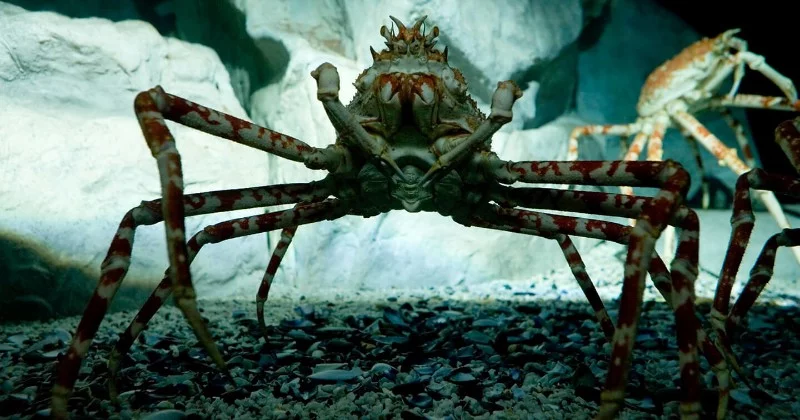
The spider crab is an omnivorous scavenger, consuming both plant substances and parts of animal origin. He is not an active predator. Basically, these large crustaceans, as a rule, do not hunt, but crawl and collect dead and decomposing matter along the seabed. Sometimes they eat algae and live shellfish. Although giant spider crabs move slowly, they are able to hunt small marine invertebrates, which they can easily catch. Some individuals are cleaners of the ocean floor from decaying plants and algae, and some open shellfish shells. The crustacean has a mild character, despite its ferocious appearance.
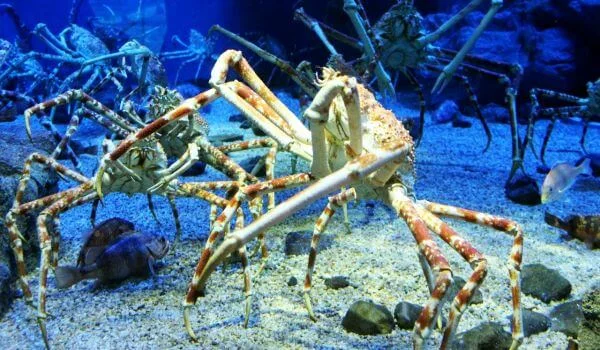
Spider crabs are very calm creatures, spending most of their days searching for food. They roam the seabed, moving casually over rocks and potholes. But this marine animal does not know how to swim at all. Spider crabs use their claws to tear apart objects. These spider crabs shed their shells, and new ones grow even bigger with age. One of the largest spider crabs ever caught was only forty years old, so it is unknown what size they may have when they reach a greater age. At the age of 10, the spider crab becomes sexually mature. Japanese laws prohibit fishermen from catching M. kaempferi during the mating season in early spring, from January to April, in order to preserve natural populations and allow the species to spawn. During incubation, females carry eggs on their back and lower body until they hatch. The mother stirs the water with her hind legs to saturate the eggs with oxygen. After the eggs are hatched, parental instincts are absent, and the larvae are left to fend for themselves. Female crabs carry fertilized eggs attached to their abdominal appendages until tiny planktonic larvae hatch. The development of planktonic larvae depends on temperature and takes from 54 to 72 days at 12-15 °C. Due to the mild nature of spider crabs, they are often found in aquariums. They rarely come into contact with humans, and their weak claws are quite harmless.
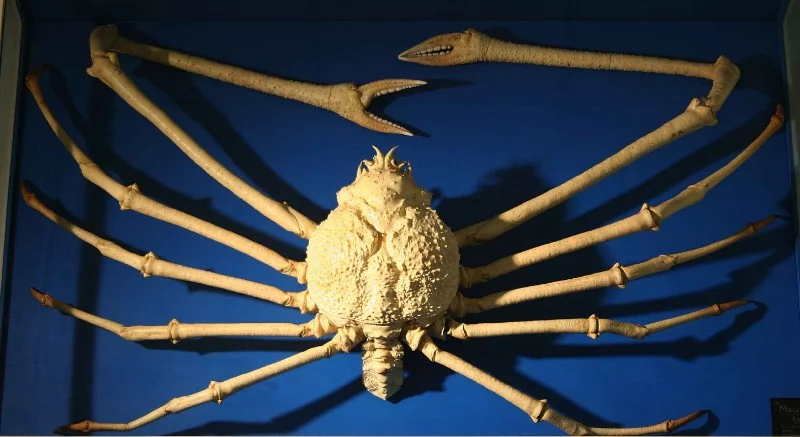
An adult spider crab is quite large, so it has few predators. He lives deeply, which also affects security. Young individuals try to decorate their shells with sponges, algae or other objects suitable for camouflage. However, adults rarely resort to this method because their large size deters most predators from attacking. Although spider crabs move slowly, they use their claws against small predators. The armored exoskeleton helps the animal to protect itself from larger predators. But despite the fact that these spider crabs are massive, they still have to beware of an accidental predator such as an octopus. Japanese fishermen continue to catch spider crabs, despite the fact that their numbers are declining. Scientists fear that its population may have declined significantly over the past 40 years. These crabs are often served as a treat during the respective fishing seasons and eaten both raw and boiled. Because the legs of the spider crab are very long, researchers often use tendons from the legs as a subject for study. In some parts of Japan, it is customary to take and decorate the shell of an animal.
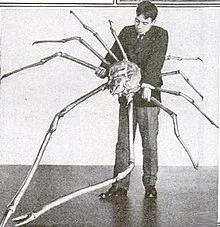
This crab specimen from the American Museum of Natural History measures 3.8 meters (12 feet) across its outstretched legs


Share:
Bestcomments (0)
There are no comments for this post yet. Want to leave the first one?