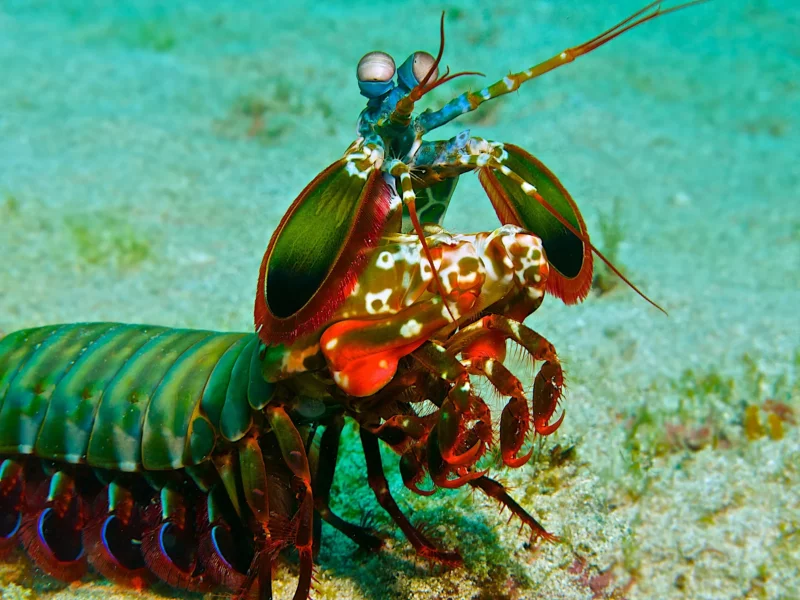
The Peacock mantis has a body size from 10 to 35 cm. The grasping legs have an unusual feature: in them the last segment is sharp, serrated, like a blade and is inserted into the longitudinal furrow of the penultimate segment, like a penknife. The first pair of grasping legs is the largest, they grab the prey, and the rest of the grasping legs hold it. It lives in tropical and subtropical seas at depths from 5 to 10 m (occasionally up to 20 m).They lead a predatory lifestyle. Rotopods spend most of their time in burrows. Climbing out, they crawl along the surface of the ground with the help of their hind pectoral legs, as well as dexterous mandibles, which bend at the same time and on which the cancer relies like crutches. Crayfish can swim quite fast.
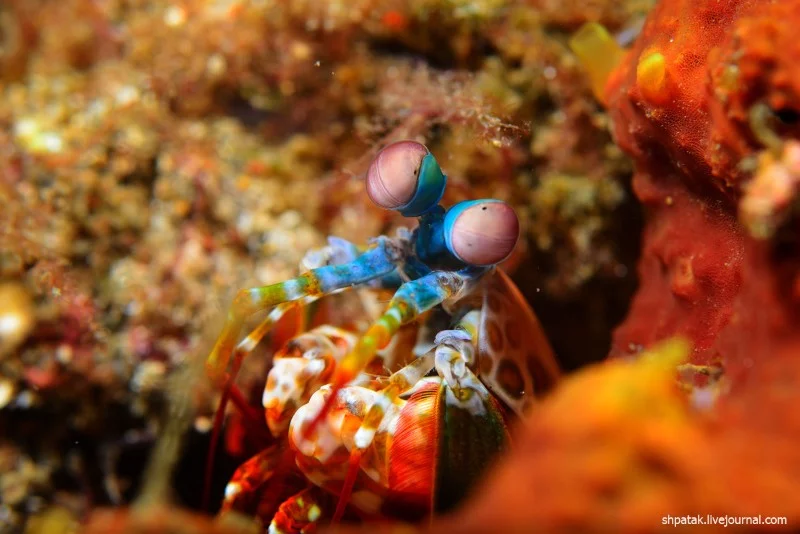
Among the currently existing animals, mantis crabs have the most complex visual system. If humans have three types of color-sensitive cones in their eyes, then mantis crabs have 16 of them. Moreover, mantis crabs can adjust the sensitivity of their long-wave vision to adapt to the environment. The middle band of the eye consists of six rows of specialized ommatidiums — sockets of photosensitive cells. The four rows contain up to 16 different pigments: 12 of them are color-sensitive, and the rest are used as color filters.
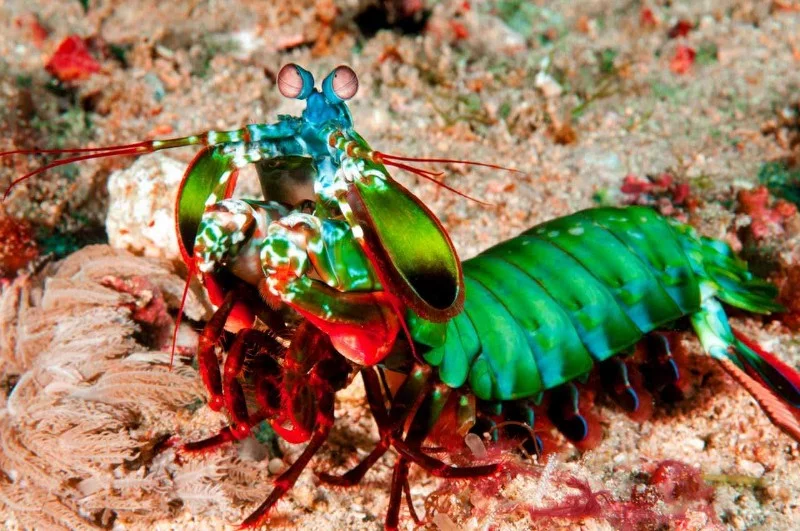
The force of the impact of his claws is comparable to the impact of a .22 caliber bullet! Mantis hits with such power that it literally tears up the water on impact. At the point where the claws click, a so-called cavitation bubble is formed: an area filled with red-hot steam and gas released from the burst water. This bubble bursts instantly, after which a powerful shock wave is formed, which by itself can kill the victim. During the impact, the claw moves underwater at a speed of 72 kilometers per hour, so the hunting throw of mantis crayfish is officially recognized as the fastest among all animals. The secret of such speed and tremendous strength lies in the special structure of the hunting paws of mantis crayfish. These animals use the so-called "latch mechanism": their paws contain a large muscle that contracts for a very long time, and a latch that restrains this very muscle. And at the moment of impact, the latch opens, and the muscle spreads with great speed — it turns out something like a shot from a bow or a crossbow. The secret of their strength lies in the content of the mineral hydroxyapatite, which dampens the force of impact. This mineral is also found in the human body: in teeth and bones.


Share:
Bestcomments (0)
There are no comments for this post yet. Want to leave the first one?