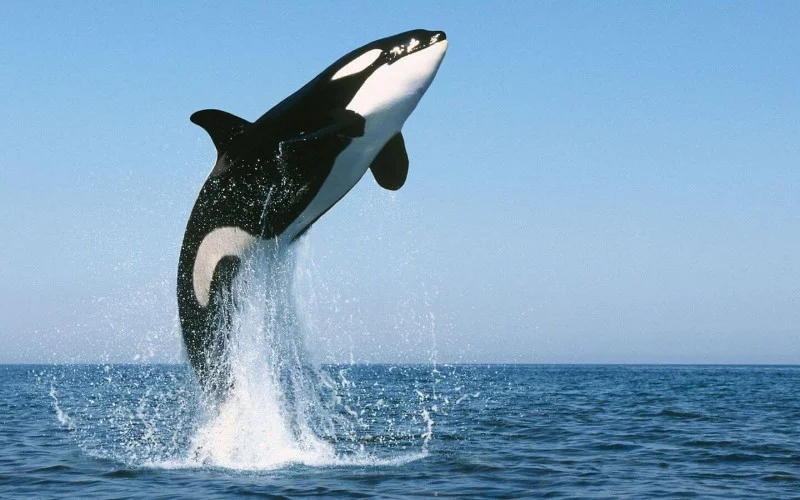
Killer whales are the largest carnivorous dolphins; they differ from other dolphins in their contrasting black and white color. Male killer whales reach a length of 10 m and have a mass of up to 8 tons, females — up to 8.7 m in length. They have massive teeth, up to 13 cm long, adapted to tearing large prey. The color of the killer whale's body is so contrasting that it seems as if its body has been opened with varnish. The location of black and white spots on the body is never repeated, as well as their size and shape. At the same time, we can safely say that the throat area of killer whales is always white, as is the belly area, along which a white longitudinal stripe of arbitrary shape runs. The average life expectancy of killer whales is 50-60 years, but in good conditions they can live much longer.Killer whales can easily dive to a depth of 300 meters, but they can stay underwater for no more than 4 minutes.
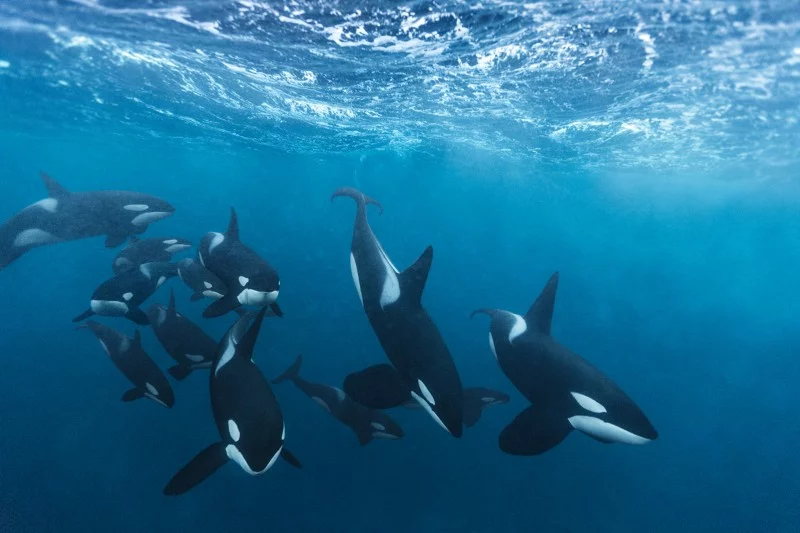
The killer whale is widespread almost everywhere The world Ocean, occurring both near the coast and in open waters, but adheres mainly to the 800 km coastal strip. It is less common in the tropics than in cold and temperate waters. There are no exact data on the total number. The minimum total number is estimated at 50 thousand killer whales
As a rule, killer whales prefer to lead a gregarious lifestyle, forming groups of up to 20 individuals. If the group becomes more numerous, then it is divided into two or more groups. Each group has its own unique set of sounds. Killer whales have a complex social organization, which is inferior in complexity of internal and external social relations only to the social structures of elephants and higher primates. It is based on a matriarchal group (family), usually consisting of a female with cubs of different ages and adult sons.
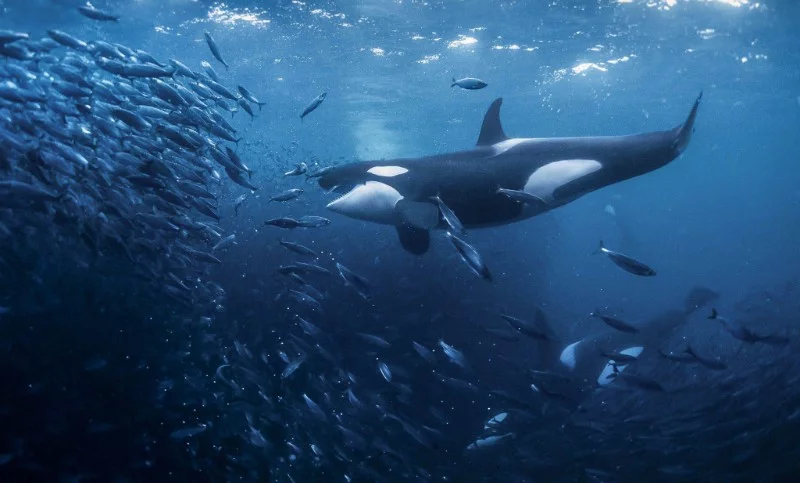
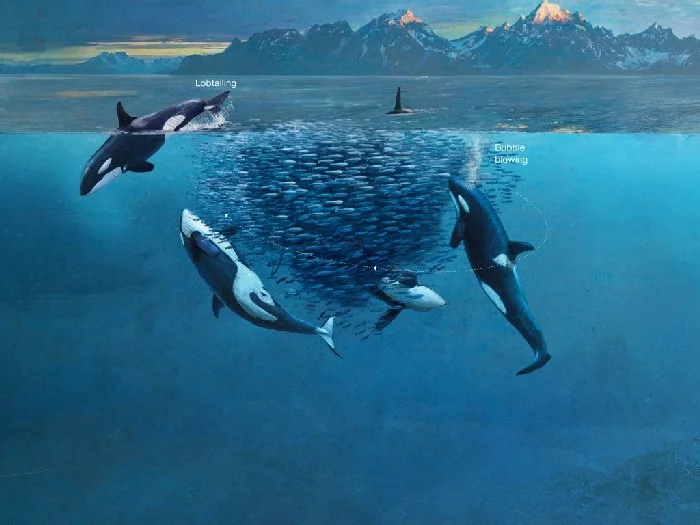
The killer whale is the top of the food chain in marine wildlife, which has virtually no rivals. Nevertheless, killer whales, as very highly developed marine mammals, have complex tactical and even strategic schemes in use, which are used by flocks for food production. In search of fish, flocks of killer whales usually turn around in a chain and swim at a speed of about 5 km/h. At the same time, echolocation signals allow each animal to determine its position relative to others, stay in contact with them and participate in the general activities of the group. Orcas pin a school of fish to the shore or drive it into a dense ball near the surface of the water, take turns diving into its middle and jamming the fish with tail blows. When hunting seals or penguins swimming on an ice floe, killer whales either dive under the ice floe and hit it, or, lining up in a line, with synchronous movements of powerful tail fins, create a directional high wave that washes prey into the sea. To instill in the cub the ability to easily manage prey on the shore, the mother forcibly pushes the cub into shallow water or even onto land, and watches it from the water if the cub is unable to cope with panic and return to the water on its own. The attack on large whales involves mainly males. They simultaneously pounce on the victim, bite her throat and fins, trying to prevent her from rising to the surface. But when attacking female sperm whales, on the contrary, they try to prevent the victim from going deep (killer whales avoid male sperm whales because their strength is great, and their jaws are capable of inflicting a fatal wound). In addition to whales, killer whales hunt white sharks, which on the one hand are seen as a food competitor, on the other hand they highly appreciate shark liver for the nutritional enzymes contained in it. A female killer whale, using hunting techniques, is able to cope alone with a great white shark, which is not much smaller than herself.
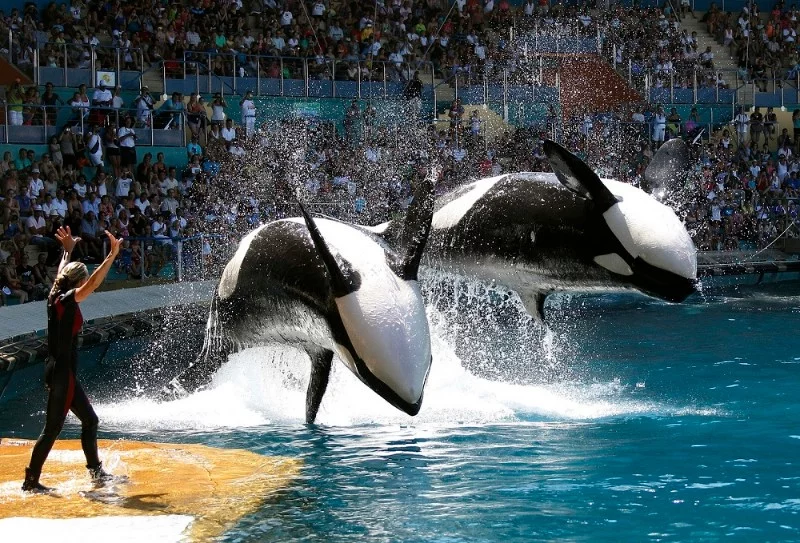
Their commercial extraction was banned in 1982. However, it does not apply to the whaling of indigenous peoples, and to the capture of killer whales for scientific and educational purposes. There are no reliable cases of human death as a result of an attack by a killer whale in the wild, which indicates that they are uninterested in humans as food. Contrary to the idea of killer whales as large and friendly dolphins, they periodically show aggression in captivity. There are individual cases of death of trainers from an attack by killer whales. The killer whales did not attempt to eat the victim whole, bite off a limb from it, chew the victim's torso with their powerful jaws, and the cases of killing people by them can be described as carried out in the least brutal and traumatic way for the dead. This indicates that killer whales are animals with a highly developed psyche, and the reasons for aggression on their part are not limited to a banal search for food, protection of territory and other primitive reasons for attack. Members of packs affected by whaling harbor resentment and can subsequently take it out on boats of equivalent size to the small-tonnage whaling vessels they remember. The experience of studying recorded cases of attacks by foreign researchers indicates that killer whales can attack watercraft, even if they are larger than themselves. At the same time, whalers themselves are not associated in their perception with the ships on which they sail, which suggests that killer whales perceive ships as an independent entity, and not a man-made means of people, and they choose ships, not people, as the object of their revenge. Due to their large size, killer whales are far from the most popular animals in aquariums, today there are about 58 killer whales in captivity around the world. Some of them were born in the wild, others knew nothing but the pool. For many years, discussions have been raging about how humane it is to continue to keep dolphins and killer whales in water parks, but this issue is still very far from being resolved.
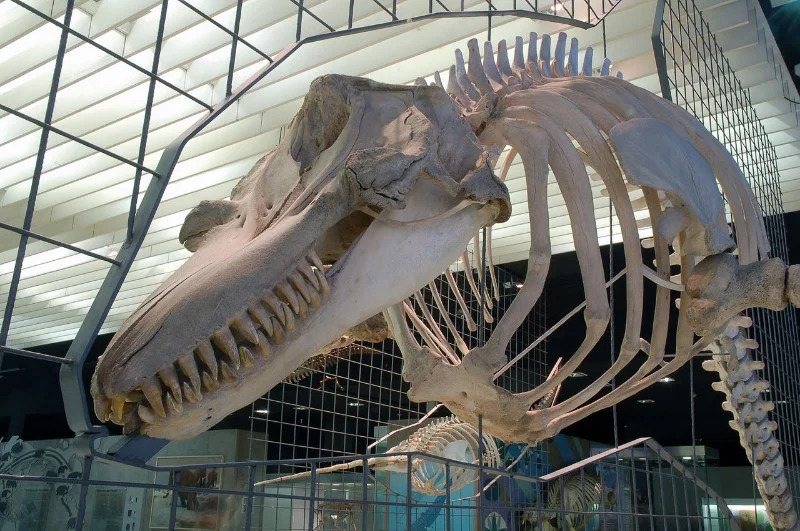
The skeleton of a killer whale



Share:
Bestcomments (0)
There are no comments for this post yet. Want to leave the first one?