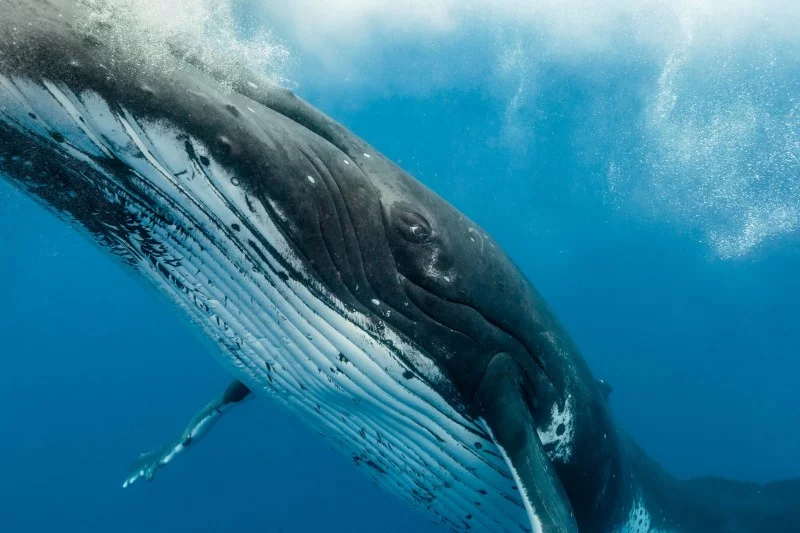
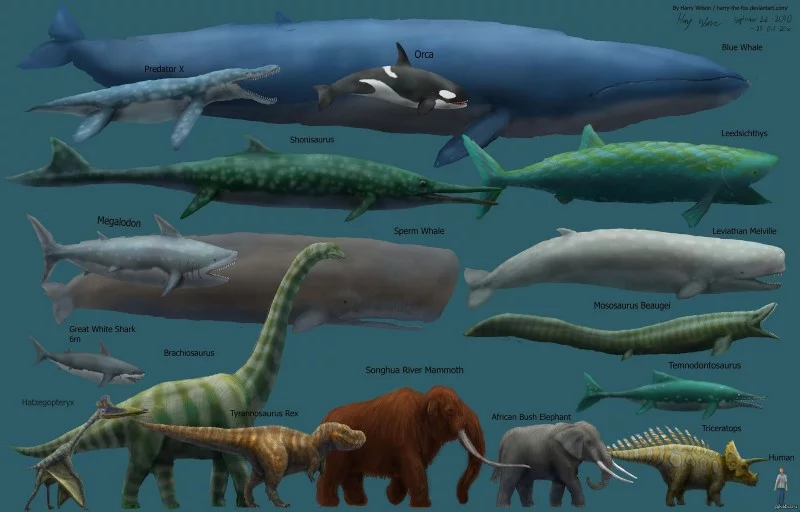
The blue whale is a marine mammal from the infraorder cetacea, belonging to the family of striped whales of the order baleen whales. The blue whale has an elongated, slender body — the ratio of length to body thickness is much greater than that of other baleen whales. The head is large, making up about 27% of the body length. When exhaling, the blue whale releases a vertical fountain of water in the form of a narrow, upward-expanding cone or column up to 9 and even 10 m high. Like all striped whales, the blue whale has a large number of longitudinal stripes or furrows on the lower part of the head, which continue on the throat and belly. They are formed by folds of the skin and play a dual role — they help the whale's throat to stretch strongly when swallowing a large volume of water with food, and also improve the hydrodynamic properties of the whale's body. The blue whale usually has 55-68 and even 80-90 such stripes. The blue whale is the largest of all cetaceans (and at the same time the largest animal on Earth). The huge size of the blue whale, according to those who have seen it, makes a strong impression. The largest recorded specimen was a female slaughtered by whalers in 1926 near The South Shetland Islands. Its length was 33.58 meters. This whale was not weighed, but its mass, apparently, significantly exceeded 150 tons. Giants with a length of 30 m or more are still rare among blue whales; the average size is slightly smaller — in The Northern hemisphere is 22.8 m for males and 23.5 m for females, and in the Southern Hemisphere it is one meter larger. According to modern research, the large size of whales is associated with the uneven distribution of food in the ocean. A large body volume allows, on the one hand, to absorb a lot of feed when it is in high concentration, and on the other, to survive for a long time in conditions of its shortage. The fat accumulated during intensive feeding allows the whale to go almost without food for several months. The blue whale's eyesight is very poor; it also has a poor sense of smell and, apparently, almost no sense of taste. However, he has excellent hearing and touch skills. The tongue of a blue whale weighs up to 4 tons. The throat of a blue whale is narrow — only about 10 cm in diameter. The heart mass of a large blue whale is approaching a ton, the diameter of the dorsal aorta reaches 40 cm. The skin of the blue whale is quite smooth and even, except for the stripes on the throat and belly. Like all baleen whales, the blue whale has several hundred pairs of baleen plates inside its mouth, consisting of a horny substance (keratin). The length of the whisker plates in a blue whale ranges from 90 cm to a meter, the largest length of the plates is reached in the back rows, closer to the front of the mouth their length gradually decreases to half a meter, the width of the plates is about 50-53 cm.
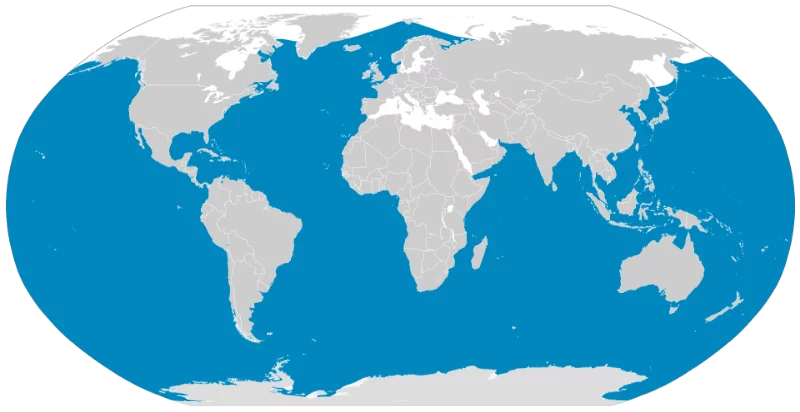
In general, the blue whale is cosmopolitan. Its historical range covered almost the entire world ocean. In the Indian Ocean, blue whales are found all year round in equatorial waters. In the eastern Pacific Ocean, blue whales begin to occur off the Chilean coast. Blue whales are extremely rare in Russian waters. The population of blue whales in the North Atlantic Ocean is few in comparison with herds in the Southern hemisphere. It is known that blue whales, which spend the summer in the high latitudes of both hemispheres, migrate to warmer areas of low latitudes by winter.
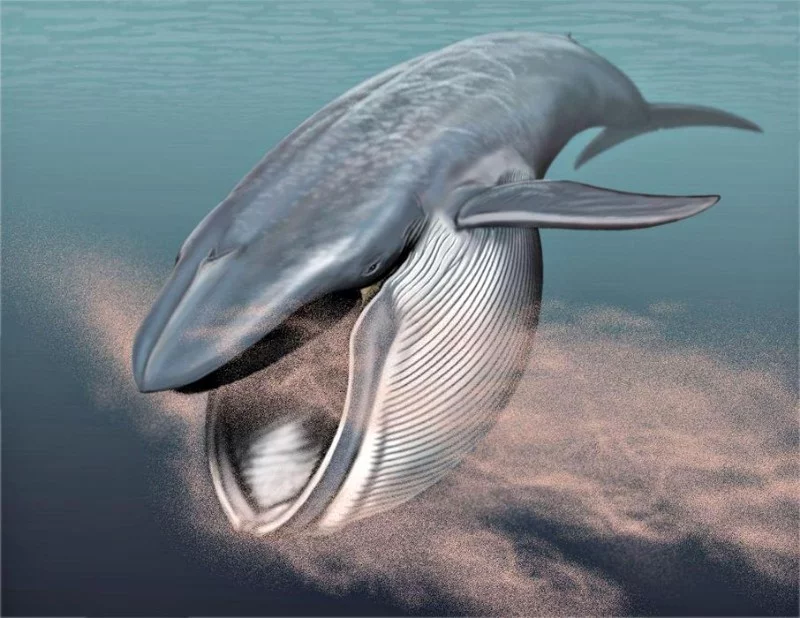
In general, the blue whale shows a tendency to loneliness to a greater extent than all other cetaceans. The blue whale does not form herds, it is mostly a solitary animal, although sometimes blue whales form small groups consisting of 2-3 heads. The blue whale, swimming near the surface of the water, is not nearly as maneuverable as some other large cetaceans. The blue whale dives quite deeply, especially if it is very scared or injured. Data obtained by whalers using special devices mounted on a harpoon showed that a harpooned blue whale can dive up to 500 m. The usual dives of a feeding whale rarely exceed 200 m, and more often they are no deeper than 100 m. Such dives last from 5 to 20 minutes. A grazing whale dives quite slowly — it takes about 8 minutes to dive 140 m and then ascend. After surfacing, the whale's breathing increases to 5-12 times per minute, with a fountain appearing each time. The caudal fin of a diving blue whale is rarely shown — in about 15% of diving cases. Observations of blue whales off the southern coast of California have shown that they spend 94% of their time underwater. At a short distance, the blue whale can swim at speeds up to 37 km / h, and in exceptional cases — 48 km / h, but it cannot maintain such a speed for a long time, because this poses too much stress on the body. At this speed, the whale develops up to 500 horsepower. Grazing bluewalker moves slowly, 2-6 km/h, faster during migrations — up to 33 km/h. The blue whale breathes 1-4 times a minute in a calm state. Studies in the 1970s showed that the breathing rate of blue whales (and tabbies in general) strongly depends on the size and age of the whale. Young whales breathe much more often than adults. The diet of the blue whale is not fundamentally different from the diet of other striped whales. The blue whale is a typical plankton eater, its food composition is dominated by small (no more than 6 cm long) crustaceans from the Euphausiaceae order, forming massive clusters, the so—called krill. A grazing whale swims slowly, opening its mouth and taking in water with a mass of small crustaceans. The stripes on the throat allow the whale's mouth to stretch very much, this is also greatly facilitated by the movable articulation of the bones of the lower jaw. Scooping up the water with the crustaceans, the whale closes its mouth and squeezes the water back through the whalebone with its tongue. In this case, the plankton settles on the fringe of the mustache and is then swallowed. The huge lower jaw, filled with water and food, has such a large mass that it is sometimes difficult for a blue whale to move it to close its mouth. Therefore, it is not uncommon for a blue whale, having gathered food in its mouth, to turn over on its side or even on its back, and then the mouth closes itself under the influence of gravity. Due to its huge size, the blue whale is forced to consume a very large amount of food — according to various sources, the bluewalker eats from 3.6 to 6-8 tons of krill per day, and it is estimated that the number of individual crustaceans in this mass reaches 40 million. The increase in the number of blue whales is the slowest among all baleen whales. Females give birth every two years. This period may sometimes vary depending on the density of the whale population and may have decreased in recent decades. Pregnancy lasts about 11 months
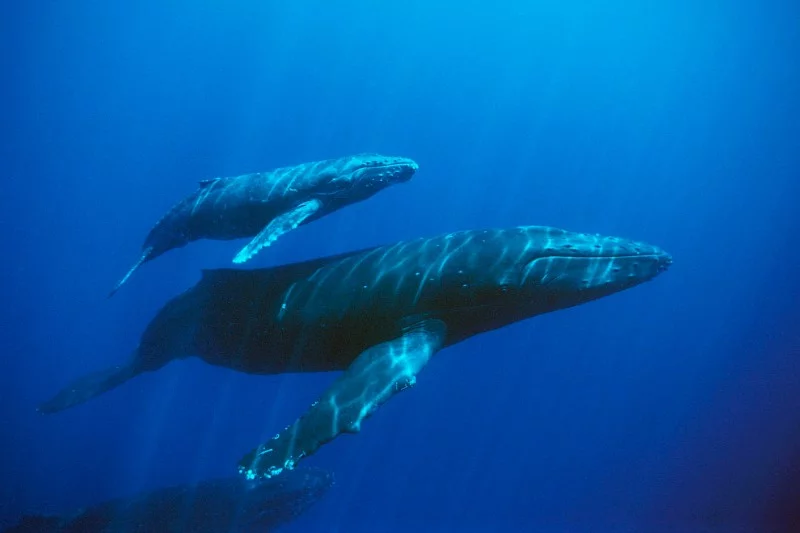
The initial number of blue whales, before the start of their intensive fishing, was estimated at 215 thousand heads. According to other sources, it could be even more, up to 350 thousand. The first bans on blue whale fishing in the Northern Hemisphere date back to 1939; they affected only certain areas. Fishing was completely banned in 1966. According to one data, there are now from 1300 to 2000 bluewales in the entire world ocean, but in this case the number of these whales is even lower than 40 years ago, despite the complete lack of fishing. Other sources give more optimistic figures: 5-10 thousand bluevals in the Southern hemisphere and 3-4 thousand in the Northern Hemisphere. The growth of the blue whale population is slow, but in some places, for example, in areas near Iceland, the increase after the fishing ban reached 5% per year. Due to their gigantic size, blue whales have almost no natural enemies. However, young and sometimes adult individuals can become victims of attacks by killer whales, which, acting together, can tear them apart and eat them. The causes of natural mortality of the blue whale have been studied extremely poorly, even in well-explored areas of the world ocean, such as the North Atlantic. Apparently, there are cases of whales dying under the ice — in the Northern Hemisphere, obviously, in late winter and early spring.
Until the 1860s, the blue whale remained virtually inaccessible to fishermen. Its colossal size and enormous strength made it an extremely dangerous opponent, given that until the end of the XIX century whaling on the high seas was not mechanized and was conducted almost exclusively from boats, using a hand harpoon. In addition, sailing schooners and rowboats could not catch up with the blue whale, and the hand harpoon did not have sufficient killing power. A dead blue whale, unlike smooth whales, usually sinks, so it is impossible to keep it on the surface with the help of boats. The first cases of targeted extraction of blue whales date back to 1868. This is due to the real revolution in whaling, which allowed the mass slaughter of striped whales, which occurred with the invention of the harpoon cannon and the so-called spear grenade. This weapon, the prototype of the 20th century harpoons used until the 1980s, was invented by Sven Foin and was a heavy metal harpoon with a powder charge in the head, fired from a muzzle—loading cannon mounted on the ship. When hit, the charge exploded, which was already enough to reliably defeat the blue whale, after which steel paws opened at the tip of the harpoon and firmly held the weapon in the carcass. Bluewall mining became widespread after The First World War. This was caused by several reasons at once — firstly, the herds of humpback whales were depleted, and it became necessary to find a new source of whale oil and whiskers; secondly, due to technological progress, whale fishing gear has become even more perfect. The peak of production occurred in 1931, when more than 29 thousand heads were scored. The main fishing areas for blue whales were located in the Northern Hemisphere off southeastern Japan, near the Kuril Islands, the eastern part of the Aleutian Ridge and to the south (in the Gulf of Alaska). Bluewalls were mined off the coasts of British Columbia, California, Mexico, and in the Atlantic Ocean — in the waters of Norway, Iceland, Scotland and Ireland and off Newfoundland; to a lesser extent off the west of Greenland, the Faroe Islands and Svalbard and occasionally off the coasts of Spain and Portugal. The last recorded cases of (illegal) blue whale fishing occurred off the Spanish coast in 1978. 45 tons of fat were obtained from one of the largest blue whales captured by Soviet whalers, weighing 150 tons. The meat of the blue whale, like the meat of other baleen whales, is quite edible, unlike the meat of toothed whales, for example, sperm whales, which has a strong unpleasant smell of blubber. The meat of young blue whales is quite soft and tender, pink-red in color. In old whales, it has a dark red color and is tough. Meat concentrate was also prepared from meat, which was a completely acceptable substitute for beef concentrate. Whalebone was very valuable before the widespread introduction of plastics, and a variety of products were made from it. At the end of the 19th century, one of the shops in Boston, specializing in the sale of whaling products, offered an assortment of 53 types of household products made of whalebone (corsets and other parts of women's and men's clothing, brushes, bed springs, etc.).

A blue whale compared to an average adult
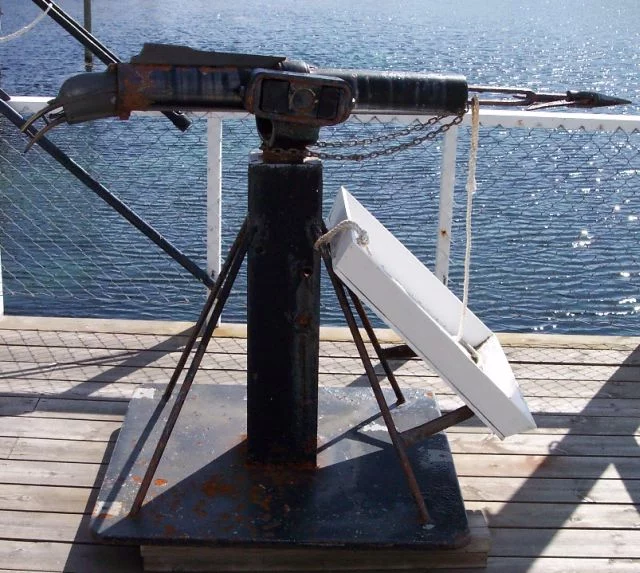
A harpoon gun. Her invention made it possible to start mass fishing for striped whales
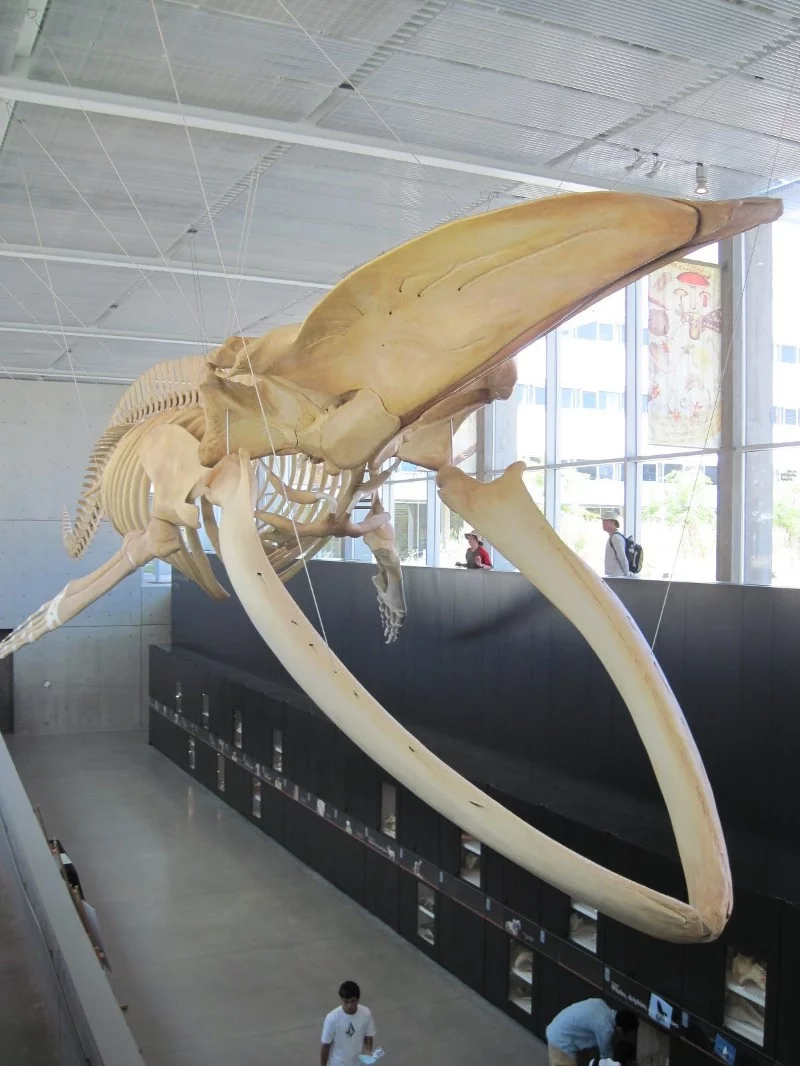
The skeleton of a Blue whale
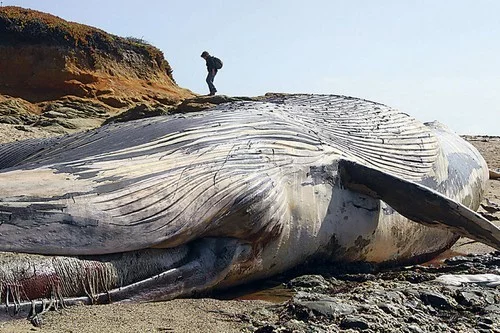
People often find the carcasses of dead whales washed ashore. Scientists still do not know the reasons why whales are washed ashore.


Share:
Bestcomments (0)
There are no comments for this post yet. Want to leave the first one?