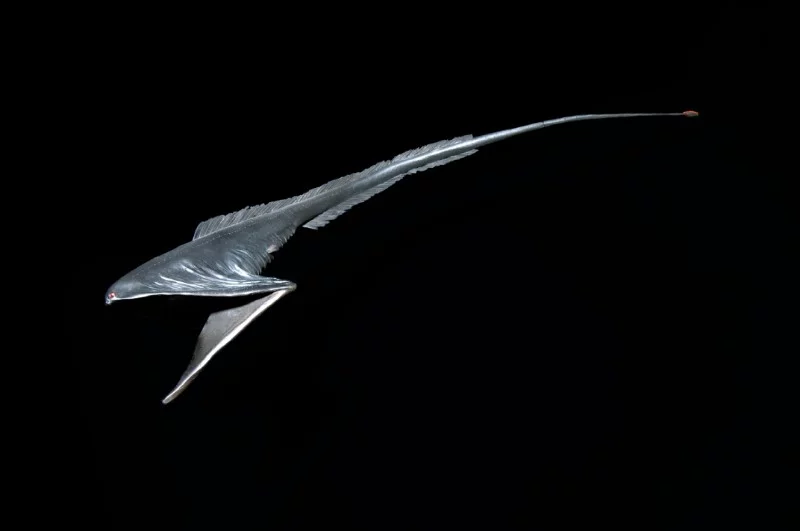
The pelican—shaped largemouth is a species of deep-sea ray-finned fish from the suborder sac-like of the order eel-like. Body length according to various sources varies from 60 to 180 cm. The weight is not more than 1 kg. The length of the mouth is about 1/3 of the total length of the body, the rest is a thin, eel—shaped body. Passing into the tail thread, at the end of which the photophore is located. In live fish, it glows pink or red.There are many small curved teeth in the jaws, arranged in several rows. The eyes are small, the anterior and posterior nostrils are in front of the eyes, close to each other. The fish lacks a swim bladder, gill covers, scales, ribs, caudal and ventral fins. The pectoral fins are poorly developed, unlike the dorsal and anal fins, which stretch almost the entire length of the eel-shaped body. There is a bright line or groove on both sides of the dorsal fin with an unknown function. On the edge of the upper jaw, just behind the nostrils, there are tiny eyes, which in the realities of the dark zone of the ocean do not play a significant role in the life of the fish. Nevertheless, fish are able to distinguish the glow from other organisms and identify the silhouettes of small organisms against the background of residual sunlight penetrating to the depth. Navigate at great depths in conditions of pitch darkness and excessive pressure (for a large mouth, this value ranges from 30 to several hundred atmospheres) The fish is helped by the lateral line, which consists of a series of convex tubes instead of holes, as is typical for other fish. The musculature of the fish is poorly developed, which is why the largemouth lacks the small fraction of prey that it manages to catch to provide its body with energy. Mollusks were found in the stomachs of 87 individuals, fish in 37, cephalopods in 15, and shells in 8. Sexual dimorphism is present. Degenerative changes are observed in males after puberty: olfactory organs increase, teeth and jaws decrease. It is believed that reproduction occurs only once in a lifetime. Spermatogenesis in males proceeds synchronously. The gonads have a lobed structure, polycyclic ovaries. Gonads increase during puberty in the abdominal cavity of fish, depress the stomach and intestines, causing their atrophy, and after spawning, the fish most likely dies. They are distributed circum—globally - in temperate and tropical regions of all oceans. They live mainly at depths from 500 to 3000 m (5000m?). Probably, after catching prey, the fish gets rid of water through the gills and swallows it. Since the stomach is not so elastic, the largemouth probably feeds on relatively small organisms.
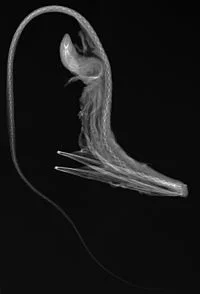
X-ray of a pelican-shaped largemouth
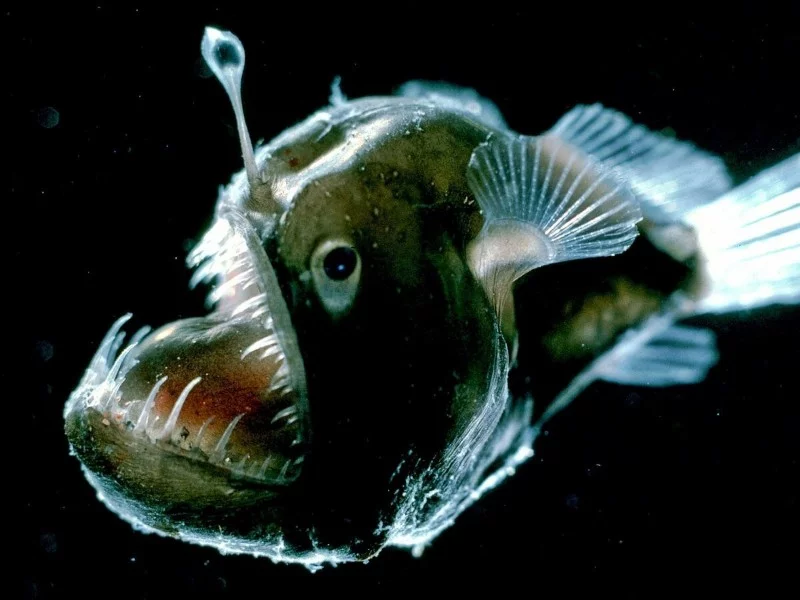
The deep-sea anglerfish is a suborder of deep-sea ray-finned fish from the order anglerfish.The size is very different from the species living at a shallower depth, they have only a few centimeters. Deep-sea anglers constantly live at great depths, 1500-3000 m, in the thickness of ocean waters. They are characterized by a spherical, laterally flattened body shape and the presence of a "fishing rod" (in females). They are distinguished from other anglerfish by the absence of ventral fins.Traditionally, it is believed that deep-sea fish in appearance are bloated bodies with bulging eyes and ugly shapes. In fact, this is not the case. Deep-sea fish take on the appearance of bloated bodies when they rise to the surface in fishing nets, due to excessive internal pressure, which is 150-300 atmospheres at depths of 1500-3000 meters. Due to the expansion of the walls of the arteries that feed the gland with blood, fish can arbitrarily cause the glow of bacteria that need an influx of oxygen for this, or stop it by narrowing the vessels. Usually, the glow occurs in the form of a series of consecutive flashes, individual for each species. From a depth of about 3,600 m, the luminous "bait" is located in the mouth. Unlike other deep-sea anglers, it hunts, apparently, lying on the bottom. Adult female anglers feed on deep—sea fish, crustaceans and, less often, cephalopods; males - paddlefoot crustaceans and bristle-mandibles. The stomach of females is able to stretch very much, so that they can swallow prey, often exceeding their own size. The voracity of anglers sometimes leads to their own death. Dead anglers were found with swallowed fish more than twice their size. Having captured such a large prey, the anglerfish cannot release it due to the structure of its teeth and chokes.
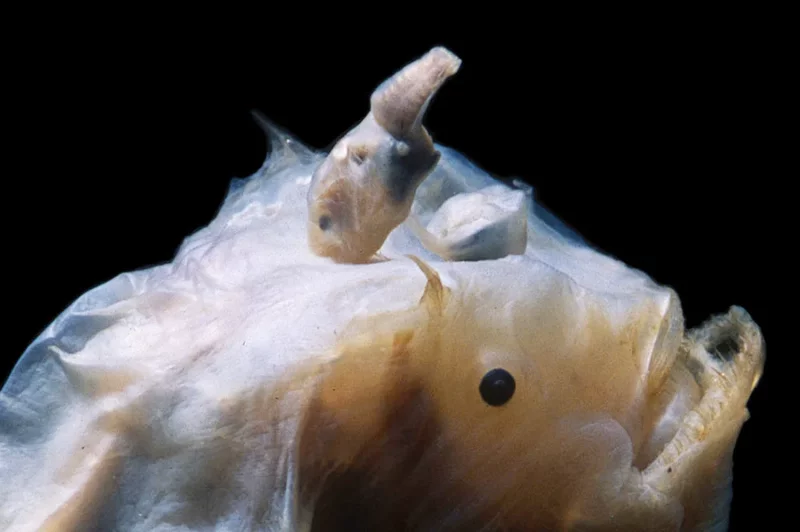
Some anglerfish families have extremely unusual relationships between the sexes that are not found among other fish and vertebrates. They are expressed in the fact that dwarf males live as parasites on the body of females. Before the transition to parasitism, males have well-developed eyes and large olfactory organs. This allows them to find females by the smell of pheromones, traces of which remain in almost still water of great depths for a long time. Approaching the female, the male apparently visually recognizes her species by the structure of the eka or by the color and frequency of her flashes. Then the male attaches himself to the side of the female with his sharp teeth. Soon he fuses with the female with his lips and tongue, and his jaws, teeth, eyes and intestines are reduced so that eventually he turns into a simple appendage producing sperm. The male's nutrition is carried out at the expense of the female's blood, since their blood vessels also fuse.


Share:
Bestcomments (0)
There are no comments for this post yet. Want to leave the first one?