Last time we discussed how to build a sentence with the verb ná (nanyë elda — I am an elf; i nauco (ná) halla — the dwarf is tall). Now let's talk about more serious matters. How do you say "you have my sword" in Quenya? And my bow, too.
The time has come. Let's move on.
Updated dictionary
(New words are in italics)
Nouns
elda — elf
tan — man
nauco — dwarf
orco — orc
elen — star
menel — sky
macil — sword
hesto — captain
aran — king
atar — father
amil — mother
aiwë — bird
ambo — hill
anga — iron
cöa — house
lúmë — hour, period of time
mindon — tower
omentië — meeting
osto — city
rotto — cave
taurë — forest
Pronouns
nyë — I
(i)nya — my
lvë — We (you and I)
(e)lva— our
lme — we (us but not you)
(e)lma — our
tyë — you
(e)tya — your
lyë — you (respectfully)
(e)lya — your
ldë — you (plural)
(e)lda — your (plural)
se — he, she, it
(r)ya — his, her
ntë — they
(i)nta — their
i — the, a, an
mo — someone
ma — something
Verbs
ná — to be
cir — cut
lor — sleep
mat — eat
men — go
nor — run
sam — have
sil — shine
tir — watch
tuv — find
Adjectives and Adverbs
luinë — blue
turca — strong
halla — high
qualin — dead
mai — well
mára — good
palan — far
oialë — forever
palan — far, far away
melda — dear, beloved
linta — fast
linquë — wet
alcarin — glorious
Ná palan...
If you have forgotten how to pronounce words or how to use the verb "ná", read the first lesson:
Now let's look at a few constructions:
Possessive Pronouns
(i)nya — my
(e)lva— ours
(e)lma — our
(e)tya — your
(e)lya — your
(e)lda — your (plural)
(r)ya — his, her
(i)nta — their
____________________
Most possessive pronouns have the same basic form as the long subject suffixes, except the -ë is changed to -a: -nyë “I” → -nya “my” and -lyë “you” → -lya “your”. The main exception is the possessive pronoun for “his, her” which is -rya. In all cases, the unmodified possessive pronoun form is added to nouns ending in vowels. For nouns ending in consonants, a “joining vowel” is generally needed to avoid awkward combinations. This joining vowel varies, and is either i or e, as indicated by a parenthetic vowel before the suffix in vocabulary entries: -(i)nya “my” or -(e)lya “your”.
For example:
eleninya — my star (elen + "i" (joining vowel) + nya; in English = starmy)
cöanya — my home (cöa + nya; cöa ends in a vowel, so a joining vowel is not needed)
aranelya — your king (aran + e (joining vowel) + lya)
taurelya — your forest (taurë + lya)
mindoninta — their tower (mindon + i + nta)
rottonta — their forest (rotto + nta)
atarelma — our father (atar + e + lma)
ostolma — our city (osto + lma)
____________________
Again, “his, her” is an exception: the suffix becomes -ya after a consonant, as indicated by the vocabulary entry -(r)ya. If the noun ends in a vowel, an -r must be added; if the word ends in a consonant, it is simply written together.
For example:
aiwerya — his/her bird (aiwë + r + ya)
macilya — his/her sword (macil + ya)
Nanyë elda!
Noun plurals
Noun plurals can be formed by adding an -i for words ending in a consonant, an -r for words ending in a vowel or changing the final -ë to -i for nouns ending in an -ë.
For example:
atan — man → atani — men
elda — elf → eldar — elves
aiwë — bird → aiwi — birds
Ná linquë...
How to connect a verb (except ná) with a noun in Present Simple
cir — cut
lor — sleep
mat — eat
men — go
nor — run
sam — have
sil — shine
tir — watch
tuv — find
____________________
The Quenya aorist is the “timeless” tense. It is used for actions with no specific time or where time is not the main focus, and thus it can also refer to the present, especially in narratives. As such, it is roughly equivalent to the English simple present: “runs”. Without other inflections, the aorist tense of basic verbs is formed by adding an -ë to the stem: nor- “to run” → norë “runs”. That’s enough information to form some simple sentences.
For example:
elda lorë — an elf sleeps (lor + "ë")
i hesto samë macil — the captain has a sword (sam + "ë")
i nauco tirë i orco — the dwarf watches the orc(tir + + "ë")
orco matë aiwi — an orc eats birds (mat + "ë")
____________________
With "you" -i is added to the word to indicate the present tense and "tyë" (you) or "lyë" (You), depending on what you want to say.
For example:
menityë — you go (men + I + tyë)
samityë macilinya — you have my sword (sam + i + tyë, macil + i +nya)
samilyë macilinya — you have my sword (sam + i + lyë, macil + i + nya)
____________________
With "I" the word order is also reversed (predicate, then subjects). -i is added to the word to indicate the present tense and -n as the correct ending for "I".
For example:
lorin — I'm sleeping (lor + i + n)
samin macil — I Have a Sword (sam + i + n)
____________________
For the plural, "i" is added to the word to indicate the present tense and "r" to indicate the plural. The word order is direct (subjects, then predicate).
For example:
i naucor tirir i orco — the dwarves are watching the orc (tir + i + r)
orcor matir aiwi — orcs eat birds

I macil ná alcarin!
The sword is yours, the stars are yours, Quenya... Well, almost... The arsenal has been replenished: plural, possessive pronouns and a couple of new words. Oh, by the way, there's something under the pictures. But it doesn't matter. Don't pay any attention.
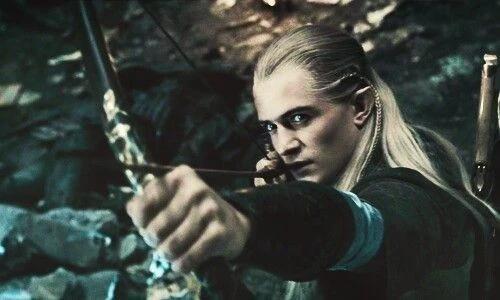
Tirin tyë!
That's all!
How does "Macilinya cirë orcor" translate?3


Share:
Bestcomments (4)
Highjacker
Samilyë eleninya! Samilyë macilinya!
zhara188
Reply to Samilyë eleninya! Sa... (Highjacker)
You have my sword too ⚔️
Anna188
It's a good idea with pictures. I accidentally translated the phrases... It's hilarious😁
zhara188
Reply to It's a good idea wit... (Anna188)
Thanks