* * *
Just the other day, I watched 3 very good movies.:
"The Elephant Man" by David Lynch [1980],
Orson's "Citizen Kane" Wells [1941],
"Monk" by David Fincher [2020].
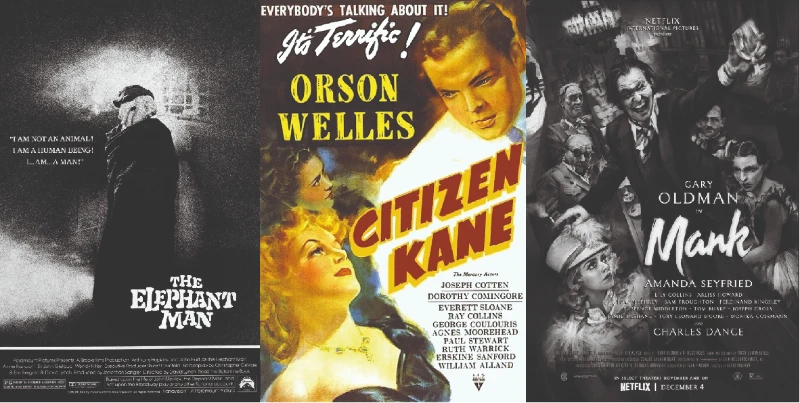
Movie posters
I'm not going to talk about these paintings now (all three are beautiful in their own way and deserve separate reviews) - oh no, the point is different.
All three films are in black and white. Realizing this, I became imbued with this aesthetic and wondered: how does the color black affect our perception of what it means to a person?
Because I started this text with films, and we will continue with them.
Why until the middle of the 20th century, films were in black and white, and why do directors still resort to this technique?
* * *
1. Cinematography in b/w.

Cinema
The monochromacy of the first films is, in principle, understandable to any Internet user – the limitations of film technology. In those days, using b/w in cinematography was precisely a necessity, and not some kind of director's decision.
Nevertheless, even after the appearance of "color" in the cinema, films such as Schindler's List, American History X, The Lighthouse, as well as the previously mentioned Elephant Man, Citizen Kane and Monk were released. They are all in b/w.
Now for a bit of decoding. Let's look at the example of two films: what, how, and why.
* * *
1.1. The Lighthouse, 2019.
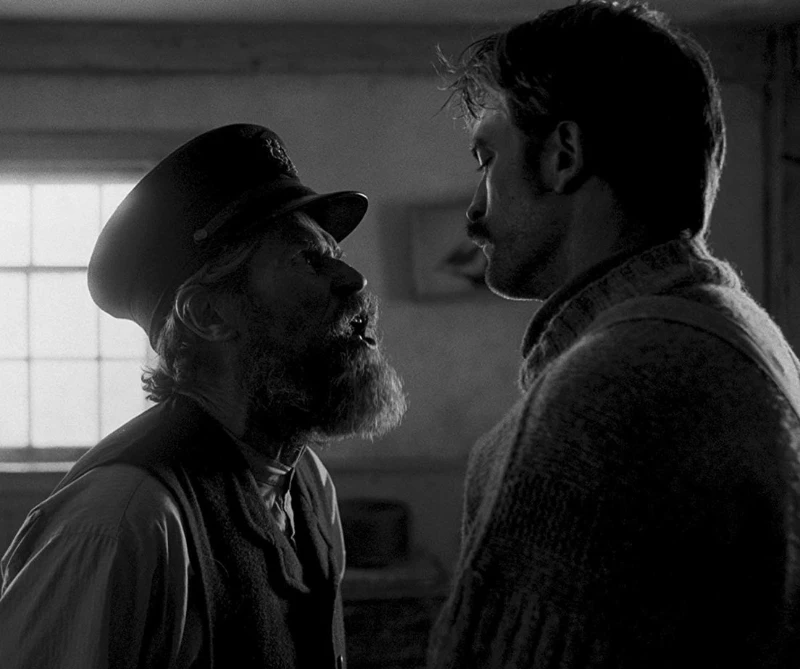
An image from the movie "The Lighthouse"
Dafoe as Thomas Wake (left) and Robert Pattinson as Thomas Howard (right)
Robbert Eggers shot a fascinating art house with two talented actors - William Dafoe and Robert Pattinson. Why is the color black here?
The entourage.
The film is filled with shots and elements that drive the viewer into a feeling of awkwardness, discomfort, disgust. From raging waves and a lonely stone lighthouse, to farting (I'm serious) and a mermaid with a huge pussy (I'm still serious). The black-and-white filter here adds to the depressing mood.
Also, b/w plays a different role here, but more on that later…
* * *
1.2. Manc, 2020.

A shot from the movie "Monk"
What is the first thing we associate with a black-and-white filter? That's right – with something old, gone.
The cultural context of the epoch.
Back in the 90s, Fincher planned to film his father's script about Herman Mankiewicz, the screenwriter of Citizen Kane, who disappeared in the shadow of the great and terrible Orson Welles.
Almost all the events of the film actually took place in the distant 30s. And in order to bring to the screens the spirit of that time and his love for Hollywood of that era, David used the chronicle style: he shot the film in black and white, imitated the film in modern digital printing and selected an authentic soundtrack.
As you can see, with the development of technology, films not only did not stop shooting in b/w, but also began to do it especially.
Nevertheless, the black color does not end with cinema: a sudden relevant fact is that I am a graduate of the graphic design specialty.
* * *
2. Black color as a tool.
Black and white logos are some of the easiest to design. The point, of course, is precisely in the combination itself: the designer / customer does not need to think about a combination of certain colors – just take and fuck black and white, a proven option. A great option. The simplicity of this combination does not negate its aesthetics.
At least, I'm more attracted to the black and white logo of a bar, barbershop , sports market, or magazine than all these colorful logos of children's stores, shopping malls, TV channels, and more.

The Playboy logo
No wonder. Indeed, in the psychology of colors, black is associated with style, solidity, classics, restrained luxury and seriousness. All this applies not only to logos and banners, but also to clothing, interiors and cars.
Yes, what is the magic of black?
In its versatility. Despite its emptiness, it has a huge number of ideas, meanings and associations. The king of flowers, who will always be a classic.
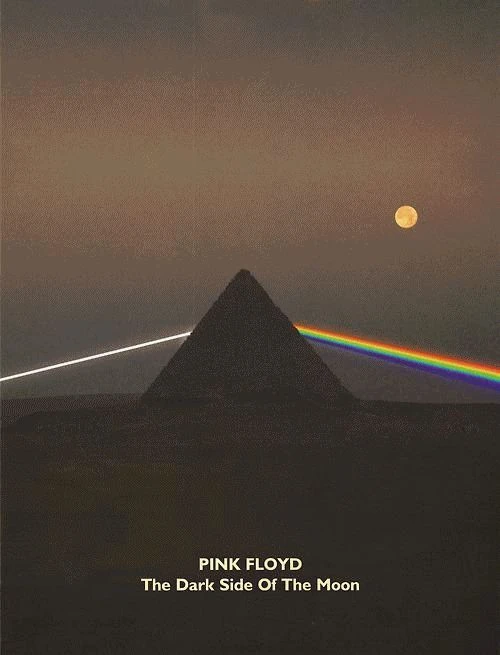
Image from the cover of the album The Dark Side Ot The Moon by Pink Floyd
Interesting facts:
- Black is the absence of light. That is why for me black is the color of purity/purification, calmness and stoicism.
- While in many countries black is considered a symbol of mysticism and death, in China it is associated with luck and peace.
- When printing products , they do not use pure black color, but composite color, for higher quality.
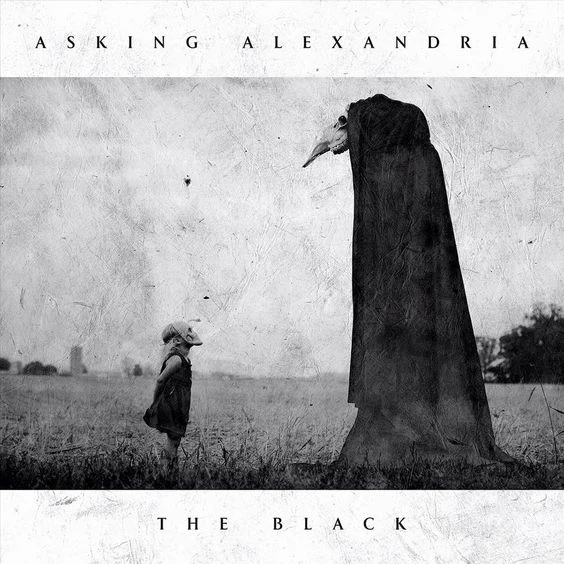
The Black album cover by Asking Alexandria
How do you feel about black?1


Share:
Bestcomments (0)
There are no comments for this post yet. Want to leave the first one?