Hello everyone, recently, but as recently as about 3 months ago, in general, what will be in this post, a review or similar reviews for all 8 seasons and my personal incorruptible opinion on them (there are more opinions), so spoilers are provided, in any case, this is a niche post on squadvarchek.

Tonight's the Night
* * *
I actually started watching this series quite by accident. I
came across a YouTube short from the fourth season. At that time, I
didn't even know what kind of sirik he was, but I kept coming across him anyway. No one I know watched it, so I had to feel it myself.
From the very beginning, we are shown Dexter's double life. At night, he shows his real self. During the day, an ordinary modest and shy guy who comes to
work, brings donuts to colleagues and lives as normal a life as possible.
By the way, he works for the Miami Police Department on homicides.
Dexter is a laboratory technician who specializes in
blood analysis, and he also collects blood from his victims, namely, takes a blood swab from each victim, so blood plays an important if not central role in Dexter's life.
Who exactly
is Dexter?
He's basically a serial killer, but not an ordinary psychopath.
He acts according to the so-called "code" that his adoptive
father Harry instilled in him.
The meaning of the code is quite simple:
1. Not getting caught is
the main rule.
2. Do not kill innocent people -
only murderers or those who have escaped justice from the authorities should become his victims, but Dexter has repeatedly ignored this rule.
First, he collects evidence, follows
the person, makes sure that he really is the killer, and only then
arranges his branded room with plastic and photos of the victims, in general, he has a whole ritual.
But so that the series doesn't just turn into
a serial killer routine, we're immediately introduced to the main antagonist of the season, the "Ice
Killer." It works as cleanly as possible.
There is no blood or footprints at the crime scenes, just neatly dismembered
bodies. Because of this, there is a theory that he uses a
refrigerator truck. Dexter is very interested in him because of his "purity", but the killer himself leaves him clues and reminders of the past, which is why Dex begins to dig into his past and his adoptive father.
In addition, we are shown the ordinary
life of the hero. Dexter has a girlfriend, Rita. In fact, he's dating her
mostly for cover. Rita has two children, Astaire and Cody, and a rather difficult past with her drug-addicted ex-husband.
At work
Dexter has a whole set of characters too.
There's Sergeant Doakes, an ex—military
man who doesn't like Dexter from the start, and it's going to be more apparent in the second season.
There is Vince, a fellow lab technician who constantly makes strange and rather vulgar jokes.
There is Angel Batista, one of the detectives, a normal guy, but with his
own family problems.
There is also Captain Matthews, a family friend and longtime colleague of Dexter's father.
And then there's the new Lieutenant Lagertha, who was assigned more because she's of Cuban descent.
And of course Dexter's sister, Debra Morgan, who
works in vice and really wants to join the homicide squad, she will succeed, because she will help find that truck with the ice killer's refrigerator, which is why she will be promoted from vice to Miami Homicide.
The entire first
season, in fact, is built around two lines:
Dexter's usual "work" as a serial killer and his attempts to understand who
the Ice Killer is and why he is so clearly addressing him.
The series also captures Dexter's own thoughts. We are shown not only the murders and his work in the department, but also how he communicates with Rita's children, with colleagues, and how he tries to look like a normal person.
Because of this, you involuntarily begin to empathize with him. Because on the one hand, he's an ordinary person, and on the other, he's still a serial killer. Even if it is valid according to the code.
The season itself ends quite powerfully. Dexter finds out that the Ice Killer is his brother Brian.
Brian kidnaps Debra and confronts Dexter with a choice: kill Debra and finally embrace his dark side by teaming up with his brother, or remain human and maintain the moral compass that the code once gave him.
And Dexter makes his choice.

You can't be both a hero and a murderer.
After the events of the first season, Dexter's life was supposed
to return to normal. He made a choice between his brother and sister,
got rid of Brian, and finally lived by Harry's code. It would seem
that you can work quietly again, meet with Rita and go about your business at night.
But the second season quickly shows that the consequences
of Dexter's past actions have not gone away.
The main problem begins with the fact that bags of dismembered bodies are found in the ocean. And it quickly becomes clear that this is not some new maniac, but Dexter's own old deeds, which he has been throwing off his yacht for years. The police are launching a massive investigation, and the press is coming up with the big name "The Bay Harbor Butcher."
Dexter, on the other hand, works in the very department that is now looking for him. He analyzes the evidence, helps the investigation and literally stands next to people who are trying to figure out a serial killer, not even suspecting that this killer is standing right in front of them.
At this point, Sergeant Doakes comes to the fore.
In the first season, he just treated Dexter with suspicion and disdain, but in the second it turns almost into an obsession. Doakes is sure that something is wrong with Dexter. He has no evidence, no concrete evidence, but there is a strong feeling that this quiet laboratory assistant is hiding something very dark. He starts following Dexter, checking on him, literally following him around. And it's precisely because of this that the tension in the season increases greatly, because for the first time a character appears who can really expose Dexter.
At the same time, the hero's ordinary life begins to crumble. Rita notices that he often disappears at night. Besides, she gets a message from Paul. He claims that he was not injected with methadone and that he was framed, but Dexter is to blame for everything. Rita, of course, does not believe him, but still begins to doubt and even checks the house.. Dexter has to come up with an explanation for his behavior, and he chooses a rather unusual option and starts pretending to be a teenager. It sounds absurd, but for Rita, this explanation turns out to be even more understandable than the truth. As a result, he starts going to anonymous drug meetings, where he meets a girl named Laila, who becomes his addiction counselor. Dexter and Lila have contact, or rather, Dex is cheating on Rita with Lila, Lila is a kind of freedom for him, with whom he can share his hobbies, and Rita is a safe, normal life. Laila will play a rather important role in the future.
Meanwhile, the investigation of the "Bay Harbor Butcher" is getting more and more complicated. The FBI is getting involved in the case of Frank Landy, an unspoken rock star among special agents, who will get very close to the truth, and many still think that Landy knew everything in advance, but here it's just a theory. Dexter's sister will work with Landy on the Bay Harbor butcher case, which will even make her fall in love with him.
Dexter has to act more and more carefully, because now not only the local cops are looking for him, but also the feds. But it is Doakes who remains the most dangerous. At some point, he starts getting too close to the truth and literally catches Dexter in the act. After that, Dexter has to act as harshly and coolly as possible, during the fight Dexter knocks out Doakes and locks him in an old cabin in the middle of the swamps.
And that's where a rather interesting dilemma arises. According to the code, Dexter can't kill Doakes. He's not a killer or a criminal, but a cop who's just doing his job. But if you let him go, then Doakes will immediately turn him in. It turns out to be a dead end: you can't kill, you can't let go, Dexter was thinking about pinning all the murders on Doakes. At that moment, it was a stupid idea, since Doakes could easily refute everything Dex said, Dexter was only helped by the fact that Dexter's collection was found in Doakes' car, namely those very blood smears, but it didn't help much before the trial, in general, it's just a dead end.
Here Laila intervenes in the story. She gradually realizes what kind of person Dexter really is, and unlike him, she has no moral doubts at all. For her, murder is not a tragedy or a dilemma, but simply a solution to a problem. In the end, everything ends rather cruelly: the hut where Doakes was held explodes, he dies, and the police officially announce that it was Doakes who was the Bay Harbor Butcher.
Dexter's crimes are simply blamed on him. Technically, Dexter is getting away with it again. The investigation is closed, the department considers the case resolved, and life seems to be returning to normal. Only Lagertha tries to refute all the evidence against Doakes, but in vain.
In general, this is a big plot hole, if it weren't for Lila, then Dexter would either have to break the code or face trial, and Lila is literally an easy solution to problems for Dex, and for the plot as a whole, if this character hadn't been introduced, then everything could have ended in the second season.
The second season is probably my favorite, there's a real pressure on Dexter, Landy and Doakes are getting closer and closer. And if you could get rid of Brian with a knife, then you already have to use deduction, psychology, and a number of other skills just to avoid getting caught.
In general, this is the best season, but the finale, of course, kills with stupidity, the writers did not find any other solution to eliminate Doakes so if Dex had killed Doakes, we could have seen the fracture inside the character, and also in the first season we were shown Dexter's moral choice, between humanity or becoming a monster, right there although they give us the moral that Dex needs to either kill Doakes or go to trial, he doesn't solve it himself, but another character decides everything, as a result, friendship will become the new theme of season 3.
After a rather intense second season, the series
changes direction a bit. If earlier the whole story was built around the fact that Dexter
could be exposed, then in the third season another topic appears: can a
serial killer even have something like friendship?
The season starts off rather
casually for Dexter. He goes to the next target of a man named Freebo,
a drug dealer who is suspected of murder. Dexter, as usual, collects
evidence, prepares everything for his ritual, but everything does not go exactly according
to plan, although Freebo is killed by Dexter, but Miguel Prado, the assistant district attorney,
who has personal scores with Freebo, suddenly bursts into the house. As a result of this whole situation, he partially becomes a witness to what
Dexter is doing. And that's where the fun begins. Instead of getting
scared or trying to turn Dexter over to the police, Miguel begins to take an interest in
him. Moreover, he gradually begins to admire what he is doing.
Dexter. For him, this is not a horror or a crime, but almost justice.
After all, Dexter, in fact, kills those who deserve to be punished anyway, just does
it faster and more efficiently than the system.
Over time
, a rather strange friendship begins to form between them. Miguel sees Dexter as a man
who can really change the world for the better, and Dexter, in turn,
feels for the first time in his life that he can share his secret with someone. Before that
, he was always one-on-one with his "dark companion," well, except for a small episode with Laila, which is why he essentially gave his addiction such a nickname. Dexter hasn't had someone who knows the truth yet, but he's also trying to get involved.
At
the same time, another big change is taking place in Dexter's life. Rita is pregnant.
This is unexpected news for Dexter, to put it mildly. He's already struggling
to cope with the role of a normal person, and then there's the prospect of becoming a father.
All season long, he's been trying to figure out if a man like him can even be
a normal father and husband.
There are changes at work too. Debra gets a new partner, Joe Quinn, who at one time annoys her and at the same time attracts her, because of Joey, an internal affairs officer approaches Debra, saying that Quinn is being treated as a corrupt policeman in the case, she wants her to help her, but Debra refuses, and she threatens her with That it might hit her career, but it won't stop her from further advancing in her career, she also decided this season that she decided to stop drinking, smoking and not having sex, but working on a case.
the so- called"Skinner" is a killer who takes people's skin off. She starts dating the informant Anton, and because of this relationship, she almost got caught up in her job, but at the end of the season, she finally becomes a real detective.
But the main problem of the season is gradually becoming
apparent- Miguel doesn't really understand the code the way he understands it.
Dexter. For Dexter, the code is a system of restrictions that helps him survive and follow the unspoken rules. He only kills those
who are truly guilty and who have escaped justice. For Miguel, it's just
a convenient excuse to kill. He begins to like the power that gives
him the opportunity to decide who should live and who should not. And it quickly becomes
clear that Miguel is starting to get out of control. He kills a man
who doesn't fit the code, simply because he interfered with his
work. For Dexter, this is becoming a point of no return. He realizes that he made
a huge mistake by telling someone about his secret. As a result, the friendship between them
turns into a confrontation. Miguel tries to play with Dexter,
manipulate him, threaten to reveal his secret if he doesn't
cooperate. But the problem is that he underestimates who he's dealing with.
There are changes at work too. Debra gets a new partner.Joe Quinn. At one time, he annoys her, and at another, on the contrary, attracts her. Because of Quinn, an internal affairs officer approaches Debra and says that Joey is being considered a possible corrupt police officer, and asks Debra to help with the investigation. She refuses, after which she gets a pretty direct hint that this could affect her career. But this does not prevent her from further advancing in her career.
Debra decides to put her life in order, stop drinking, smoking and stop sleeping with random people. However, all this falls apart pretty quickly, because during the investigation of the so-called "Skinner" killer, who takes people's skin off, she begins dating an informant named Anton. This relationship almost creates serious problems for her at work, but at the end of the season she still gets what she was aiming for, becoming a real detective.
The season finale is pretty predictable, but still intense. Dexter realizes that
the only way to stop Miguel is to kill him. As a
result, Miguel ends up on Dexter's desk.
The third season dropped compared to the first and second, in these two seasons we were shown Dexter's past, there were interesting antagonists, the unsurpassed Brian Moser, who is still considered better than Dexter, and also probably the best antagonist, because he is not like everyone else, Sergeant Doakes, he is not a murderer, but just a man who I did my job, and I almost completed it.
The topic of friendship in the third season, although interesting, quickly breaks down, in season 3 there is no tension, drama and emotions like in the past, there is no moral dilemma, we can only see what happens if a serial killer gives the power to kill a person who does everything only for profit, and there is a logical outcome, but the authors will correct In the next season, season 4, the theme of the new season will be family life, as Dexter and Rita get married at the end of the season.

I will do what I want, when I want, and with whom I want. Count on it!
After a rather weak third season, the creators pull themselves together and release the fourth, which many still consider to be the best
season of the entire Dexter.
And, to be honest, it's hard to argue with that. If the third
season looked like a slightly protracted experiment with the theme of friendship of a serial
killer, then the fourth returns the series to what it does best: tension, psychological games and the very unpleasant consequences of a double
life.
For me, this season was the starting point of my acquaintance with the series,
because it was thanks to him that I first heard about Dexter.
By this
point, Dexter had completely drowned in his double life. On the one hand, he
is still the same maniac with a code who methodically tracks down murderers and kills them on his desk. On the other hand, he is now a full-fledged family man.
He has a wife, a house, a child, and an attempt to look like a completely normal
person. And it is here that the series finally begins to honestly show that
it is almost impossible to combine all this in practice. If earlier problems in his
life appeared because of work, colleagues or relationships, now that's it.
it is much more banal and this makes the banal household even more difficult.
Dexter moves
in with Rita, and they have a baby. Garrison, who naturally demands
constant attention. As a result, Dexter hardly sleeps, constantly walks tired, makes mistakes at work, and falls asleep during his nighttime outings, and generally
begins to look like a man who is about to fall apart. And this, by the way, is one
of the most mundane, but at the same time the most realistic conflicts of the season.
Against the
background of all this, the main antagonist of the season, Arthur Mitchell, better
known as "Trinity", appears. And this is where the scriptwriters literally get into the top ten.
Because Trinity is, in fact, Dexter's potential future. The same
serial killer, only he lived with it much longer. He also has
a family, children, a home and an image of a respected person. Only if you look
closely, it becomes clear that his psyche is completely broken. He has
his own rituals, his childhood traumas, and a very strange sense of control
over life. And watching Dexter begin to literally obsessively study
this man is actually very interesting. Because for the first time in a long
time, he doesn't just want to remove another target according to the code. He's trying to figure
out how it's even possible to live a double life for so many years and not collapse
completely.
And then the series gradually begins to break the illusion. Because
Arthur's ideal family is a facade. In public, he's an exemplary father and
the husband participates in charity and looks like an exemplary citizen. At home
, he behaves like a real tyrant, keeping the whole family in constant fear. And
the more Dexter watches this, the more he begins to realize that his
own dream of a normal family life with such activities
, to put it mildly, looks like self-deception. The tension is really
getting a lot more this season. Dexter begins to infiltrate Arthur's life under an assumed name Kyle Buttler. He is gradually gaining confidence in the family.
Mitchell becomes something of a family friend. Up to a certain point, Dexter even tries to understand
To understand Arthur's logic and motives. But when he finally sees what
's going on inside the Mitchell family, all this analysis quickly
ends. At one point, he almost kills Arthur right there, but still
holds back. The most unpleasant part starts next. Because it turns out that
Trinity is also far from an idiot. He gradually begins to suspect Dexter, and
then completely comes out to him. At one point, Arthur even comes straight to the
police station and talks calmly with Dexter, already knowing who he
really is. And this is a really significant moment of the season. Because before
that, Dex had no opponents who could
get so close to him and still remain so dangerous.
At the same time, the police are
hunting for the Trio. Frank Landy returns to the case, who is already retired, but wants to finally catch one of the most famous
serial killers. Debra joins him in the investigation. And
this is where her serious personal problems begin. The relationship with Anton
begins to crack at the seams, because he constantly leaves for another city for
work. Against this background, an old bond rekindles between Debra and Landy. But
it doesn't last long, of course. When Landy gets too close to
The trio even accidentally meets with Arthur in the city, not knowing who he really is, and they have
to pay for it. At night, the Trio's daughter attacks them in the parking lot. For Landy, this attack
becomes lethal. Debra survives, but remains in a difficult emotional
state both because of Landy's death and because of guilt towards Anton.
The season finale, as befits Dexter, looks like a victory at first. Arthur tries
to escape from Miami, but Dexter still catches up with him and puts him on his branded table.
The hunt for the Trinity itself was quite difficult, but in the end it all ends
with the usual ritual. But there is one problem, the consequences. The trio was no
ordinary maniac who just happened to get in Dexter's way. This
is a man who has been killing for almost thirty years and perfectly understood how
fear and revenge work. And when Dexter returns home after his so-called victory, he
finds something he wasn't ready for at all. Rita lies dead in the bathroom, with
her veins cut, just like the Trio killed their victims in their murder cycle. And next to it, in a bathtub full of blood, sits little Harrison. And
this is one of the most powerful and violent moments of the whole series. Because it
's a mirror image of Dexter's own past. When Harry found him, just
like a little kid, sitting in a pool of his mother's blood. It was only then
that Brian Moser was with him. Now his own son was in that place
. Dexter just stands there in shock, picks Harrison up and calls the police.
The fourth
season really gave the series that peak, which it will never
come close to again. After that, Dexter will gradually start to slide. But it was the fourth season that remained in
the fans' memory as the very moment when the series was at its maximum
potential.

Hello Dexter Morgan
The fifth season
is essentially based entirely on one question, what to do next after Rita's death.
Because last season's finale literally turned Dexter's whole life around.
Now he is not just a man with a double life, but a widower with three children and
a baby in his arms, who witnessed the same trauma
that Dexter himself once went through. Dexter has been in
a rather strange state since the beginning of the season. On the one hand, he tries to portray a grieving
husband, because others expect this from him. On the other hand, he himself does not
fully understand what exactly he should feel. His emotions have always been
pretty blunted, but here is a situation where he is expected to have a normal
human reaction. He begins to think that perhaps it was his life as a maniac
that led to Rita's death. After all, Trinity killed her because of him. And for the first time in a
long time, Dexter begins to seriously wonder if he's ruining
the lives of everyone around him.
Rita's children are also grieving her
death, and Astaire blames Dexter for everything, which makes him feel even
worse. Dex realizes that he can't handle three children at once, so they
go to Paul's grandparents, even though Cody doesn't want
to leave Dexter. As a result, he is left alone with Harrison and his job, and this
further knocks him out of his usual rhythm.
The police are actively investigating
Rita's death, considering her to be one of the victims of the Trio, and Dexter has to constantly
stay close to this case, pretending that he is as shocked as
everyone else. Dexter is also becoming suspicious of Joey Quinn. He finds it
strange how calm Dexter called the police and how he generally behaves
after his wife's death. Joe notices that the people around him and even Dexter's neighbor
are more worried than he is. Plus, he's starting to find similarities between
Dexter and a man named Kyle Buttler, which is why he decides to figure
it out himself and hires Detective Stan Liddy, a former cop who was fired from
the police for corruption.
Meanwhile, Dexter hires a babysitter for Garrison so
that he can have some free time. He convinces himself that if he finds a victim, he can regain control of his life. After renting a truck
for transportation, he accidentally discovers blood, which leads him to a gang
of people who kidnap girls, mock them, and then dispose of their bodies.
The first person Dexter comes across is Boyd Fowler, a seemingly
ordinary guy who cleans up animal corpses. It is through this case
Dexter meets Lumen Pierce, a girl who miraculously survived the
kidnapping and witnesses Dexter kill Boyd.
And that's where
the series starts playing with a pretty interesting theme again. Lumen is not just
a bystander. She's been through hell herself, and now she's obsessed with taking revenge on the
people who did this to her. As a result, Dexter and Lumen form
a rather strange relationship. In fact, for the first time he encounters a man
who wants to kill not because of psychopathy, but because of trauma and a desire
for justice. Lumen asks Dexter to help her find the other members of this
group. And, quite unexpectedly, he agrees, though not immediately. He
understands that if he doesn't help her, she'll start acting on her own and almost certainly get herself into trouble.
During the season, they gradually begin to reach out to the rest
of the members of this company. Each of them has money, connections, and the ability
to get away with it. For Dexter, this situation is becoming quite unusual.
Because he used to act alone and always kept his distance. And now he has a man next
to him who knows his secret and actively participates in his ritual. And at
some point, something like an emotional bond even begins to form between them
. For Lumen, Dexter becomes the person who helps
her take revenge and regain control of her life. For Dexter himself, she
becomes the person who accepts him for the first time without fear or disgust, as
well as the one who helps him forget at least a little about the pain after Rita's death and
even feel something like a new love.
While Dexter and Lumen
are gradually coming out to the members of this group, the police are also starting
to get closer to the truth. Liddy begins to secretly follow Dexter, gathering
evidence that he leads a very strange nightlife. He shows
all this to Quinn and wants him to arrest Dexter. But Quinn no longer wants
to continue this case. Lagertha suspends him because he's digging
into Dexter, so he calls Liddy off and tells him to stop investigating.
But Liddy is unstoppable. He illegally acquires surveillance equipment through
Quinn's name and begins tapping Dexter and Lumen. Dexter quickly
realizes that he is being followed and tries to figure out who is doing this. But
Liddy strikes first, he kidnaps Dexter and keeps him in the car,
waiting for Quinn to arrive and arrest him. But Joey doesn't make it. Dexter regains
consciousness, frees himself and kills Liddy right in the car. When Quinn arrives, he
can't find anyone, but Liddy's blood is dripping onto his shoe. Due to the fact that
Liddy was involved with Quinn, he himself begins to be suspected, and he is taken away for
questioning. Debra is furious to learn that he was digging under Dexter. But Dexter
ends up helping Quinn get away with it, because it's completely
unprofitable for him to continue investigating this case.
While Dexter
was dealing with Liddy, Lumen was trying to get to the leader of the entire group, Jordan Chase. But he falls into a trap and finds himself in his captivity. Dexter finds Lumen, but
gets into an accident on the way, rushing too fast. As a result, he too finds
himself trapped by Chase. They are both tied down, but they combine and eventually get selected.
The finale takes place on Dexter's desk, where Lumen finally takes revenge on Jordan Chase for
everything he has done and kills him. But at that moment, Debra arrives at the place. She
enters the room where the ritual is taking place, but sees only two silhouettes behind
the curtain. She points a gun at them and talks to them. By this time
, the police had already seen the recordings of the brutal tortures committed by this gang, Debra had never watched them and was horrified by their deeds, and therefore perfectly understands what the surviving girl went through. She also knows the theory
that one of the victims managed to escape and that a man is helping her. In the end
, she decides to just let them go.
But then there is a rather important
moment for the whole story. After all the culprits are dead, Lumen realizes
that her desire to kill has disappeared. The very darkness that had driven her to revenge
had simply disappeared. And unlike Dexter, she can get back to normal.
That's why she's leaving. And this is a pretty strong moment for Dexter himself.
Because he understands one unpleasant thing.Lumen was able to stop. But he's not. His
dark companion will not disappear, no matter how much he tries to convince himself
otherwise.
The fifth season ended up being quite ambiguous. After
an incredibly powerful fourth season, it was very difficult for him to maintain the same
level of tension. But the season has
one strong side: it shows the consequences. It shows that life
Dexter will never be the same after Rita's death. And that every
time he tries to let someone into his secret, everything ends the same way, that person either leaves or dies.
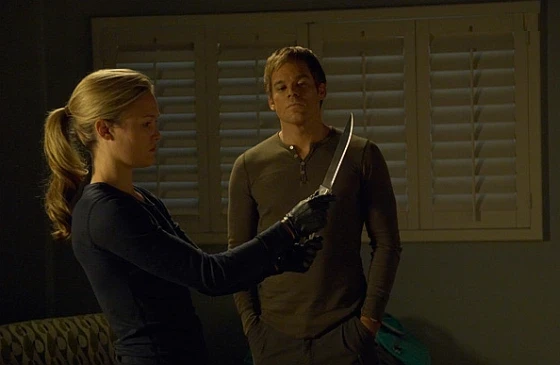
After a rather mundane fifth season, the series is once again
trying to raise the stakes and add a new idea. If earlier it was about the past, exposure, friendship, family, consequences and place, then the sixth season suddenly begins
to play with the theme of faith.
By this point, Dexter's life is back on
track. After Lumen's departure, he is left alone with his dark
companion again. Garrison has grown up a bit, Dexter continues to work for the police.
Miami, and its nightlife is slowly becoming what it used to be again. But
there is still a rather strange emptiness inside him. Lumen was able to escape
her darkness, but he wasn't. And it's starting to gnaw at him a little bit.
Everything changes
when a new serial killer appears in Miami, whom
the press quickly dubs the "Doomsday Killer." This maniac arranges murders
that look like biblical prophecies. The bodies of the victims turn into creepy
installations, referring to the apocalypse. The crime scenes are becoming more and more
strange and frightening, the victims are literally sewn into mannequins, the
bodies are displayed as part of some kind of religious painting. In general,
it all looks like a very sick interpretation of the biblical texts. Behind all this is
a rather strange duo, an elderly religious studies professor James Gellar and his
student Travis Marshall. Gellar is a man who is literally obsessed with the idea of the end
of the world. He is convinced that humanity is mired in sins and that divine
punishment is coming soon. At first, Travis looks more like a man who has been dragged into
all this. He doubts, is afraid, and sometimes even tries to stop. But
Gellar's influence is gradually dragging him deeper.
For Dexter, this story
becomes interesting for two reasons. First, the scale of the murders and their
strange religious logic. Secondly, the very theme of faith, which is always for him.
It was something rather alien. Dexter had never really thought much about God, the soul
, or morality in a religious sense. His only reference point has always been the code. But now he has a young son, and he begins to think about
a rather unexpected thing, and what Garrison will believe in at all.
Against this background
, Dexter's brother Sam appears in Dexter's life, a former criminal who was once
in prison, but now has become a deeply religious man and helps former
prisoners to start a new life. He even tries to talk to Dexter about faith
and how a person can change. It sounds pretty
weird to Dexter, but these conversations are starting to get stuck in his head.
As a result, Brother Sam is killed. At first, Dexter thinks about the bandits who came to Sam, but Dex chases them away using a police badge. Later it turns out that Sam was killed by his own student Nick, who worked at his auto repair shop and whom Sam protected in every possible way. Before Sam dies, he says he forgives Nick. After that, Dexter decides not to kill him and meets with him. He tells Nick that he knows what he did. Nick admits that he had to prove himself to the gang and prove his worth. He says he would like to meet Sam, but Dexter informs him that Sam has died. Nick replies that it's even better that way, and begins to laugh, realizing that now no one can betray him. Nick's behavior enrages Dexter, and he attacks him, drowning him in the water. When Dexter comes out of the water, he sees his dark companion in the form of Brian Moser.
It's an interesting point, because in moments with Brian, he acts recklessly, and even kills a non-murderer, but after coming to his senses, he returns to the bright side, which is personified by Harry Morgan.
The Debra line is developing in parallel. By this point, she finally becomes
a lieutenant and actually heads the homicide department. And that's where the series begins
to gradually lead her to one very unpleasant truth. The more cases she
investigates, the more often her own brother finds himself in them in some strange way
. These are not full-fledged suspicions yet, but the first disturbing
thoughts are already beginning to appear.
Meanwhile, the Doomsday Killer's case is
getting crazier. The police find more and more crime scenes, each of
which symbolizes another execution from the apocalypse. But gradually
it becomes clear that there is one rather important detail in this story. James
Gellar, who appears next to Travis all the time, has actually been
dead for a long time. His body lies in a refrigerator in an abandoned church. So this whole duet really only existed in Travis' head. He was just
talking to a dead mentor whom he had killed himself. When Dexter
finally realizes this, it becomes clear that this is not just a fanatic, but
a man who has completely lost touch with reality. Travis is convinced that
he is fulfilling a divine mission and that his actions are part of a great plan.
The season finale is happening again according to the usual pattern. Dexter finds Travis. He even tries to sacrifice Harrison, but Dexter manages to save his son and puts Travis on his table in the church. But this time, everything is not going exactly according to plan. While Dexter performs his ritual and kills Travis, Debra unexpectedly enters the church.
And this is where the series takes one of the most important turns of all time.
Because Debra is finally seeing something she wasn't supposed to see. In front of her stands
her own brother with a knife in his hands, next to the tied body and with all the preparations, which has long become the trademark style of the Butcher from
Bay Harbor. And at that moment, her whole worldview just collapses.
The fact is that this is due to Dexter's usual inattention. Debra asked the church to clean up, and he ended up doing his own ritual there. Debra, on the other hand, was going to him for a completely different reason. She wanted to declare her love for him. Yes, no matter how strange it may sound, but during the sixth season, Debra really begins to think about her feelings for her brother, and sessions with a psychologist only strengthen this, to put it mildly, strange idea.
The sixth season
itself turned out to be quite controversial. Many people did not like the line with
religious fanaticism and the antagonist himself was not as memorable as, for example, Trinity. But this season has one very important role, it finally breaks the main barrier of the series. Because all this time Dexter lived
in relative safety, where his secret was known either by enemies or random
people who eventually disappeared. But now the truth has been revealed by a man who is closer to
him than anyone else. And from that moment on, Dexter's story begins
to move in a completely different direction.
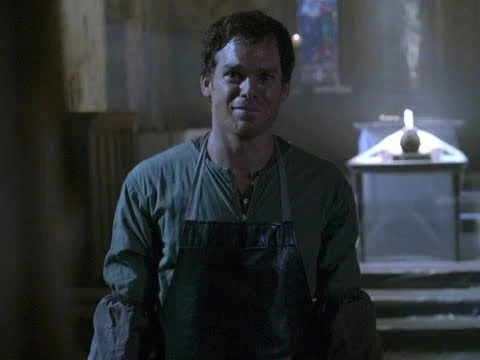
After a rather controversial sixth season, the series is finally doing
what it has been going for a very long time, completely breaking the usual formula. If before
the main question was always whether Dexter would be exposed or not, now this
issue has already been resolved. Because in last season's finale, Debra
saw with her own eyes what her brother really does. And from that moment on, the whole
story abruptly changes direction.
The seventh season is essentially built around one
simple thing, what to do with the truth. Immediately after the events in the church, Debra
is in complete shock. She can't believe what she saw. Standing in front of her
is her own brother, the man she considered the closest and
most reliable person in her life, and yet he turns out to be a serial killer.
And not just a murderer, but the very Bay Harbor Butcher that the police
once searched all over Miami. For Debra, this is literally the destruction of her entire
worldview. At first, she tries to find at least some rational explanation
for what is happening. Dexter tells her about the code, that it
only kills those who are murderers themselves and those who were able to escape justice. But to Debra
, it sounds like complete madness. She's a cop, and for her, the very idea that
someone can decide who should live and who shouldn't is contrary to everything she
believes in. At one point, Debra even tries to force Dexter to turn
himself in to the police. But gradually she begins to realize one unpleasant thing, if the truth
comes out, it will ruin not only Dexter's life, but also Harrison's, and her own.
Because she had been working next to him all this time and hadn't noticed anything. Plus
, the story of the Bay Harbor Butcher and the fact that the police actually blamed everything will come up.
Doakes. And then the whole department will come under attack. Therefore, Debra finds herself in a very
strange situation. On the one hand, she hates what Dexter is doing. On the
other hand, she's still his sister. And all season long, she's literally
torn between wanting to stop him and trying to protect him.
At the same
time, a new antagonist of the season, Isaac Sirko, appears, an influential man who is in the Ukrainian mafia. His story begins after Dexter kills
Viktor Baskov, a man from his organization. Victor was not just a member
of a gang, but a man to whom Isaac was very strongly attached. Therefore, for
Sirko, it's all becoming a personal war. Unlike many past opponents
Dexter, Isaac doesn't look like a typical maniac or madman. He is quite
a calm, cold and calculating person. Moreover, he quickly
realizes that Dexter is not an ordinary criminal. And their confrontation turns
more into a kind of game of respect between two very dangerous people. Interestingly
, Isaac even begins to treat Dexter with
a certain understanding at some point. They both live a double life and both understand what
it's like to hide your true nature. At some point, their conflict even
begins to resemble a strange form of mutual respect. But the mafia line is
only part of the season. More importantly, at the same time Dexter gets to know
Hannah McKay.
She appears in the poisoning case and quickly
becomes a suspect. But when Dexter starts digging deeper, it becomes
clear that Hannah is also a murderer. And here begins a rather strange part
of the season. Instead of just making her another victim according to the code,
Dexter begins to take a liking to her. Moreover,
a romantic connection quickly develops between them. The problem is, Hannah is a completely
different type of killer. She doesn't live by the code and kills those who just stand
in her way. For her, it's not a ritual or a philosophy, but rather a tool. And
here a rather interesting conflict arises. Because Dexter is meeting for the first
time a man who accepts him completely, but at the same time he is
quite dangerous and unpredictable.
Also related to this is the Butcher's investigation from
Bay Harbor suddenly resurfaces. And the person who starts to dig in
this direction is Maria Lagertha. She begins to suspect that the case
with Doakes might not be as simple as previously thought. Gradually, she
comes across an increasing number of strange coincidences that are somehow
connected with Dexter. And it is this line that is gradually becoming the main threat
of the season. Because if Lagertha gets to the truth, it won't just
be a family drama anymore, it will be the end for Dexter. Debra interferes with Lagertha in every possible way, as does Dexter, but this does not lead to the best ending.
The season finale is again
built around a rather difficult choice. Lagertha is practically going to
Dexter even sets up a trap to prove that he is
the real Butcher from Bay Harbor. In the end, everything ends up in an abandoned
warehouse, where Dexter, Lagertha and Debra find themselves. Lagertha realizes
that she was right all along, and tries to convince Debra to shoot her own brother, Dexter does not resist, but on the contrary tells her to shoot him. And
this is where the series takes one of its cruelest turns. Because in the end
Debra makes a choice. She shoots, but not at Dexter. The bullet hits Lagertha. And
at that moment, Debra breaks down completely. Because for the sake of his salvation
She had just killed an innocent man.
In many ways, the seventh season
turned out to be one of the strongest after the fourth. He finally reverses
the usual formula of the series and puts at the center of the story not another maniac, but
the consequences of the truth, which can no longer be forgotten. Now Dexter is no longer just
a man with a secret. Now his secret is shared with Debra. And the price of this mystery
it gets much higher.
Season 7 was the peak after the fourth, I was waiting for the moment with Dexter's disclosure for Debra for a very long time, and in fact it was justified, we see Debra tossing from side to side, as she definitely did not expect that her best brother was a serial killer all this time, because of this she is torn from the inside, and the moral choice is worthy at the end, then we move on to the most scandalous and worst season of Dexter.

The eighth season of Dexter was supposed to be the big
finale of the entire story, but in the end it turned out to be the most controversial and criticized season
of the series. After the powerful and tragic finale of season seven, the stakes were high: Debra's story, Lagertha's death, and Dexter's exposure were bound to
lead to serious consequences. However, the season is heading in a rather unexpected
direction and is trying to complete several storylines at once.
The events begin about six months
after the finale of the previous season. The lives of all the characters have changed noticeably. Debra
is completely destroyed after Lagertha's murder. She no longer works for the police, she stopped contacting Dexter, and began working as a private investigator. At the same time, she
is still deeply depressed, abusing alcohol and even dabbling in drugs, clearly unable to
cope with what she has done. Guilt literally destroys her from the inside out.
Dexter, on the other hand, is trying to get everything back to normal. He still works for the police, takes care of Harrison, and tries to act like nothing happened. But there is a huge distance between him and Debra. She blames him for what happened and believes that he is the reason she became a murderer. This is becoming one of the main emotional lines of the first half of the season.
At the same time, a new character appears in Miami, Dr. Evelyn Vogel, a neuropsychiatrist who unexpectedly finds herself connected to Dexter's past. She claims that she once worked with Harry Morgan and helped him create the very code by which Dexter lives. Vogel calls Dexter an ideal psychopath and considers him a kind of successful experiment. The most interesting thing is that only now we are learning about her, the character was introduced rather hastily, and this is very striking.
This discovery slightly changes the perception
of the whole story. It turns out that the codex was not only Harry's idea, but also his own.
a kind of psychological project by Vogel. She begins to help Dexter and even
supports his lifestyle, believing that in this way he directs his dark companion in the right direction.
At
the same time, the main antagonist of the season "Brain Surgeon" appears. This
is a serial killer who removes parts of his victims' brains. His crimes become the central investigation of the Miami police. It soon turns out that
this killer is connected to the past of Vogel herself.
It
turns out to be Oliver Saxon, her own son, who
had been presumed dead for many years. Unlike Dexter, he grew up without any code or
control and turned into a completely uncontrollable killer. Thus
, the series tries to show a kind of contrast between two psychopaths, those
who have been taught to control their darkness, and those who have not been stopped by anyone.
Meanwhile, Debra is gradually coming back to life. Her relationship with Dexter begins to recover a little, although the guilt does not disappear anywhere. The situation becomes especially difficult when Debra tries to get rid of Dexter and even plans to kill him and die with him, but eventually saves him. Vogel helps them get closer, thanks to her specialization, she tries to help them sort themselves out. Perhaps without her, Dexter and Debra would not have been able to restore at least some kind of relationship.
Another important line of the season is the return of Hannah McKay. She reappears in Dexter's life, and an affair begins between them again. This time Dexter begins to seriously think about how to completely change his life. He dreams of going to Argentina with Hannah and Harrison and starting all over again, leaving his past life behind. Dexter himself begins to believe that he will be able to abandon his dark companion and live a normal life. This idea becomes the main goal.Dexter in the final part of the season.
But Debra is against it. She doesn't trust Hannah because she once tried to poison her. That's why Dexter even framed Hannah in the past and turned her in to the police. But despite this, they still couldn't be without each other.
Later, Debra begins to change her mind. After living with Hannah for a while while she is hiding from the authorities, she realizes that Hannah is not such a bad person. Besides, Hannah gets along well with Harrison. In the end, Debra comes to the conclusion that Dexter deserves to be happy after all.
However, events are beginning to unfold tragically. Oliver Saxon kills Dr. Vogel right in front of Dexter. Later, Dexter catches Saxon, but at some point decides that it's over, he doesn't want to kill anymore. So he calls Debra to come and arrest him.
And here begins one of the strangest and most illogical parts of the season. Dexter leaves Saxon conscious and next to his toolbox. He doesn't stay in place to help Debra arrest him, but simply leaves because he's afraid of missing his flight.
At this point, the sheriff's officer who was looking for Hannah intervenes. He finds Saxon and frees him, believing that he is the victim. The officer immediately pays for this mistake and Saxon kills him. After that, Debra enters the room. A shootout begins between her and Saxon. She shoots at him, but he manages to shoot back and severely wounds her. As a result, Debra ends up in the hospital.
Initially, the doctors say that everything is fine, but then a complication occurs, and Debra
he finds himself in a state from which it is impossible to get out. For Dexter, this is the final
blow. He realizes that everything that happened to Debra is the consequence of his
own life and his secrets.
In
the season finale, he makes a decision that should be a kind
of punishment for him. He turns off Debra's life support machines and takes her body to the
ocean, where he previously sent the bodies of his victims. Dexter then abandons his escape plan with Hannah and
Harrison. He understands that the people around him are always in danger. So he fakes his death
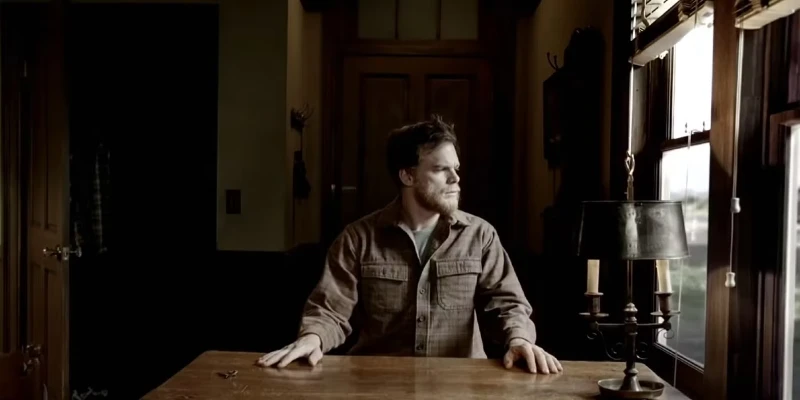
during a hurricane and disappears. The last
scene of the series shows that Dexter actually survived. He lives under a new
name and works as an ordinary lumberjack, completely isolating himself from the world and from
the people he once loved.
It was this ending that caused a huge wave of criticism, and in many ways it was well-deserved. Instead of showing Dexter alive, a stronger ending could have been his death or capture. This ending looks rather strange and leaves a feeling of understatement, and some events in recent episodes seem frankly illogical.
It is also impossible not to recall the main antagonist of the season. As a result, Oliver Saxon still dies at the hands of Dexter, but in himself he turned out to be an extremely faceless character. This antagonist is almost unremarkable and looks like he was introduced simply because the season needed another psychopath.
The Lumberjack
Well, what can I write here, that's all, I finally finished writing this post, I wrote it for three days, and I got pretty steamed up, I liked Dexter in many ways, but as for me it could have been shortened, doubled, and served in a more ideal form, but we have that we have, do I recommend watching it, yes, I think it's not the worst work, and I would give it a 7/10, based on the bastard ending and not the best decisions of the scriptwriters, will I watch the rest of the parts, yes, although I really dissuade myself from it, but on this ciao, I'm waiting for two likes on this post.
I will be able to answer the comms (if they are here) only on 10 at 22:26, due to blockages

My idol
Do you think our world needs Dexter Morgan?0


Share:
Bestcomments (2)
Haskatinka
A smotret' to stoit??
JokerC
Reply to A smotret' to stoit?... (Haskatinka)
treba