Do you like cooking shows and food videos? The ones where the host is cooking something delicious, and your mouth is watering. However, most of the time, we have to make do with snacks like sandwiches or, at the very least, pasta and a sausage.
However, in theory, everything that the chefs on TV are cooking with such skill can be replicated at home. The only difference is that some of these dishes have been discontinued over time. However, even in these cases, there is still hope, as the production techniques have not disappeared, and with the right effort, these dishes can be recreated.
However, there is one category of dishes that cannot be tasted even in theory. These are the dishes that cannot be purchased in stores, grown at home, or ordered through delivery services. In this article, we will explore the dishes that have disappeared from our lives forever (well, almost forever). We will start with something more familiar and have a small chance of being revived, and then move on to something more mysterious.
I suggest that you sit back, grab a snack, and enjoy this article, as you are unlikely to find the items mentioned later.
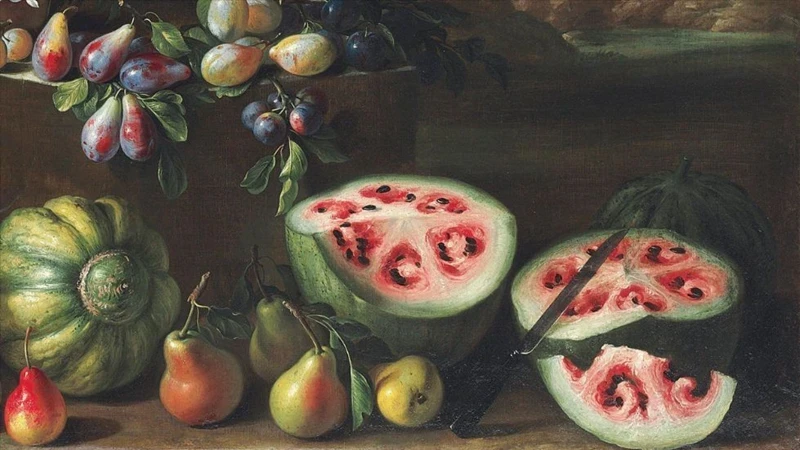
It's impossible to imagine summer without the juicy, red, and oval friend that we all love so much. Yes, I'm talking about the watermelon. As the classic saying goes, "Give a man a fish and he'll be happy all day, but give him a watermelon and he'll be pissing all night." However, has the watermelon always been the same as we know it?
Nope, it hasn't.
In fact, the watermelon itself originated either in southern Africa (where there's rampant HIV and drug addiction) or in northeastern Africa (where there's a hellish desert and civil wars). Over the centuries, it gradually made its way to the regions of the Middle East, northern Africa, and Asia. From there, it made its way to Europe through the Crusades. Interestingly, it arrived in a slightly different form compared to what we're used to. The flesh was white, the seeds were several times larger, and the shape was spherical.
The old watermelon bore a striking resemblance to its desert-dwelling cousin, the colocynth, which sometimes resembled the old berries. However, there was a significant difference in taste. While the colocynth was bitter and unpleasant, the watermelon exuded a delicate sweetness. In essence, the taste of the old watermelon was not significantly different from the new one, as breeders focused on altering the appearance rather than the taste.

By the way, I've never been a fan of dates. However, to be fair, I've only ever eaten them dried. Perhaps they taste better when fresh.
So, what was I talking about?
Dates! They are the main symbol of Egypt and other Arab countries. In fact, almost all the dates we grow today are imported from Egypt. However, this wasn't always the case.Since ancient times and up until the Middle Ages, Judea was the primary center for growing date palms. It's no coincidence that one of the most significant Semitic states in history is known by its Greek name, Phoenicia.
Judean dates were considered the standard in the Mediterranean region and beyond. This had a significant impact on the region's culture, as the date palm was the symbol of Judea.However, things didn't stay the same forever. Over time, the region became more arid. The date palms that grew along the banks of the Jordan River, the Dead Sea, and the Sea of Galilee, which required abundant moisture, gradually declined and eventually disappeared in the 14th century.
However, things didn't end there. Recently, during the excavation of King Herod's palace, seeds of the Judean date palm were discovered. One of these seeds has already sprouted and may soon bear fruit.

To be fair, not all extinct animals are out of reach. Thanks to genetic charlatans, you can still try a mammoth meat patty. However, it will cost you a pretty penny. Despite its antiquity, the mammoth has been well-preserved (thanks to its habitat), unlike the other three fascinating animals I've included in this post.

I suggest switching from vegetables and meat to spices. Sylphy is one of them.
In general, initially silphium is a plant of the umbrella family, which includes hogweed, carrot, and coriander. It has found special use in the Mediterranean, being used as a spice and medicinal preparation (and also to stimulate miscarriages).
Sylphius was very popular and very expensive. However, due to the desire of people to store it as much as possible, as well as the difficulties in cultivation, the plant began to gradually die out.According to legend, the only leaf Pliny the Elder found was sent to Emperor Nero, who just took and ate it.
Anyway, only Sylphy's closest relative, Asafoetida, has reached us. It was known to both the Greeks and the Romans, who considered it only a cheap and less refined analogue of this bizarre extinct plant.

All of the things I listed above were quite popular in the past. Descriptions of the taste and use of all those products have reached us. The latest product for today, or rather even a group of products, is so unexplored that its existence as a whole raises questions. We are talking about the unique fruits that grew on the Pacific Easter Island.
Despite the fact that Easter Island is now practically devoid of forest cover, previously a subtropical broad-leaved forest grew throughout its territory, covering 90% of the island. Among the species growing there was the palm Paschalococos disperta, which served as the main source of wood and food, in the form of coconuts.
However, all (or almost all) palm trees of this species were cut down and destroyed even before the arrival of Europeans on the island, and therefore, the species was not recorded or studied in any way, and all that remained of it were the shells of nuts that had once been eaten. In this regard, it is not known exactly what they tasted like.Presumably, there are several other species that were destroyed as a result of the exploitation of the island by the local population long before the arrival of Europeans.
* * *
I hope you were interested, friends! See you soon in new gastronomic journeys!
Which of the above would you try?1


Share:
Bestcomments (0)
There are no comments for this post yet. Want to leave the first one?